
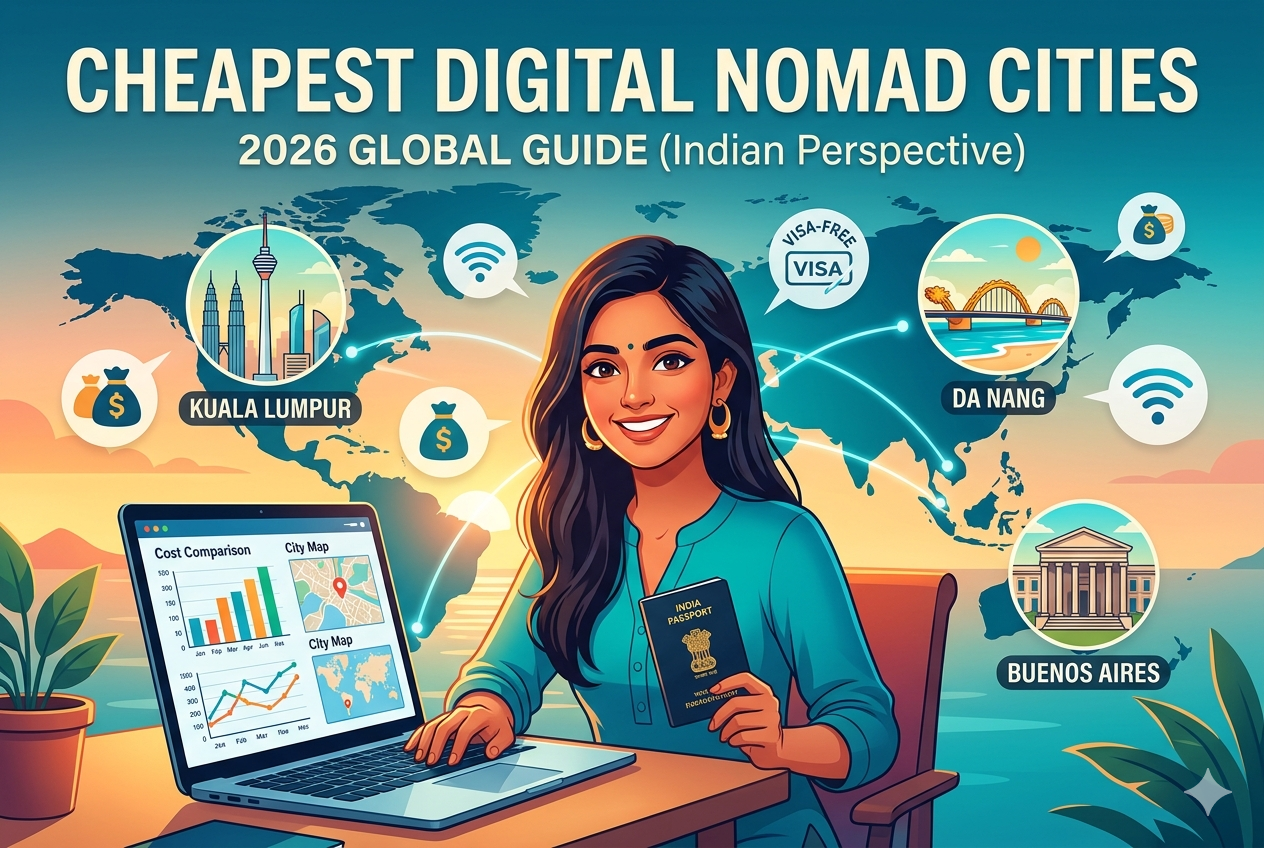
The definition of a “cheap” digital nomad destination has fundamentally changed. In 2026, finding a budget-friendly base is no longer just about geographic arbitrage—it is about avoiding the “nomad tax” in saturated hubs like Lisbon, Chiang Mai, or Bali, where short-term rental premiums have erased the cost-of-living benefits.
Today, the most strategic remote workers are optimizing for a trinity of factors: low baseline costs, generous long-stay visa infrastructure, and favorable tax regimes.
However, your passport heavily dictates your options. While Western passport holders can border-hop with ease, digital nomads from emerging tech hubs—particularly India, which now exports a massive wave of remote freelancers, B2B SaaS Marketers/founders, and agency owners—must filter these destinations through a different lens. Passport strength, processing times, and tax residency (NRI status) play a massive role in destination selection.
Whether you are bootstrapping a startup, freelancing, or maximizing a remote salary, these six cities offer the highest quality of life for the lowest monthly spend in 2026, complete with strategic insights for Indian passport holders.
At a Glance: 2026 Digital Nomad Value Index
| City | Est. Monthly Cost (Solo) | Avg. Internet | Standard Visa Pathway | Indian Passport Pathway (2026) |
| Tirana, Albania | $700 – $1,000 | 50 Mbps | 1-Year Visa-Free (US) | e-Visa / Visa-Free (with US/UK/Schengen) |
| Da Nang, Vietnam | $800 – $1,000 | 80 Mbps | 90-Day E-Visa | 90-Day E-Visa |
| Tbilisi, Georgia | $750 – $1,200 | 60 Mbps | 1-Year Visa-Free | e-Visa (Requires strict DuVerify AI check) |
| Buenos Aires, Argentina | $800 – $1,100 | 100 Mbps | Digital Nomad Visa | AVE (if holding US/Schengen visa) / DN Visa |
| Medellín, Colombia | $900 – $1,300 | 80 Mbps | V-Type Nomad Visa | V-Type Nomad Visa / Visa-Free (with US/Schengen) |
| Kuala Lumpur, Malaysia | $1,000 – $1,500 | 300 Mbps | DE Rantau Pass | Visa-Free (30 Days) / DE Rantau Pass |
1. Tirana, Albania: Europe’s Best-Kept Budget Secret
While Western Europe continues to price out early-stage entrepreneurs, Albania remains one of the last true budget havens on the continent. Tirana offers a highly functional, safe, and culturally rich European lifestyle without the Schengen-zone price tag.
- The Lifestyle: Tirana is famous for its cafe culture, boasting more coffee shops per capita than almost anywhere else in Europe. Neighborhoods like Blloku are packed with trendy workspaces, modern apartments, and excellent Mediterranean dining. The city is highly walkable, deeply affordable, and geographically positioned for cheap weekend flights across the Mediterranean.
- The Costs: A one-bedroom apartment in the city center can easily be found for less than $450 a month if you negotiate a multi-month lease. A standard meal out costs between $5 and $8.
- The Visa: The biggest draw for US citizens is the ability to stay for up to one year visa-free.
- The Indian Perspective: Albania is highly accessible for Indian remote workers in 2026—but it requires a strategy. If you hold a valid, multiple-entry US, UK, or Schengen visa that has been used at least once, you can enter Albania visa-free for up to 90 days. If you do not have a strong Western visa, Albania’s new Type C e-Visa system is available online (costing roughly €30), but requires robust financial proof (minimum €50 per day of stay in your bank account).
2. Da Nang, Vietnam: The Ultimate Beach-to-Budget Ratio
Da Nang sits squarely in the “sweet spot” of Southeast Asia. It lacks the overwhelming density of Ho Chi Minh City while offering substantially more infrastructure than smaller island towns.
- The Lifestyle: The My An neighborhood has developed into a dense nomad enclave, offering high-speed fiber internet, boutique coworking spaces, and modern beachfront condos. You can finish your workday, grab a $2 bowl of world-class Pho, and be on the beach in five minutes.
- The Costs: Your money stretches incredibly far here. A luxury studio apartment with a rooftop pool generally runs $350 to $500 per month. Renting a scooter adds just $50 a month, making daily life practically frictionless.
- The Visa: Vietnam’s visa policy has stabilized, with 90-day multi-entry e-visas now standard. For longer stays, border runs to neighboring Laos or Cambodia are cheap and easily organized.
- The Indian Perspective: Da Nang is arguably the most frictionless choice for an Indian nomad bootstrapping a business. The 90-day E-visa is universally available for Indian passports and costs approximately $25 USD. Furthermore, geopolitical ties between India and Vietnam are exceptionally strong in 2026, leading to a massive increase in direct flights (via VietJet and Air India) from Delhi and Mumbai to Vietnam. Culturally, the abundance of fresh produce, rice-based dishes, and a growing Indian expat community makes dietary transitions seamless.
3. Tbilisi, Georgia: The Tax Haven of the Caucasus
Georgia has rapidly emerged as one of the most strategically valuable countries for remote professionals. It blends ancient architecture and rich food culture with some of the most aggressive pro-business policies in the world.
- The Lifestyle: Tbilisi is distinctly unique, serving as a cultural bridge between Eastern Europe and Asia. The city is highly walkable, deeply historical, and packed with an increasing number of 24/7 coworking spaces to accommodate North American time zones.
- The Costs: While rent in central neighborhoods like Vake or Vera has crept up slightly, a budget of $1,000 a month still provides a highly comfortable lifestyle, including a private apartment, frequent dining out, and weekend trips to the Caucasus mountains.
- The Visa & Tax: Citizens of nearly 100 countries can enter and live in Georgia visa-free for a full year. Independent contractors can register as an Individual Entrepreneur and pay a flat 1% tax rate on gross turnover (up to roughly $180,000 USD equivalent).
- The Indian Perspective: For Indians, Georgia is a high-reward, but high-friction destination. While the 1% tax scheme is highly lucrative for Indian agency owners and freelancers, the visa process requires precision. In 2026, Georgia enforces a strict AI-powered document verification system called “DuVerify.” Indian applicants face a ~12% rejection rate, usually due to missing the 24-hour DuVerify link window, submitting blurry bank statements, or a lack of strong financial ties. To succeed, Indian nomads must maintain ₹50,000–₹75,000 consistently for three months before applying and submit immaculate, high-resolution scans.
4. Buenos Aires, Argentina: World-Class City on a Shoestring
Buenos Aires offers the cultural depth, architecture, and culinary scene of Madrid or Paris, but at a fraction of the cost—provided you are earning in foreign currency (USD or EUR).
- The Lifestyle: Often called the “Paris of South America,” Buenos Aires is a massive, sprawling metropolis. Neighborhoods like Palermo Soho and Belgrano are filled with digital nomads, exceptional steakhouses, and a nightlife scene that does not even begin until midnight.
- The Costs: Due to Argentina’s complex economic situation and favorable exchange rates, foreign currency goes remarkably far. You can rent a gorgeous apartment in the city’s most affluent neighborhoods for $500 to $700 a month. Premium grass-fed steaks paired with Malbec wine rarely exceed $15.
- The Visa: Argentina offers a Digital Nomad Visa granting a 180-day stay (renewable once).
- The Indian Perspective: The biggest hurdle for an Indian nomad choosing Buenos Aires is pure geography—flights from India to South America are grueling (24-30+ hours) and expensive. However, if you already possess a valid US B2 Visa or a Schengen Visa, you can bypass complex embassy visits and apply for an AVE (Electronic Travel Authorization) online. If you are a digital marketer or tech worker optimizing for US time zones, the jet lag trade-off is often worth it, though the time difference from Indian Standard Time (IST) is drastic (8.5 hours behind).
Buenos Aires, Argentina. Source: Erik Gonzalez Garcia / Getty Images
5. Medellín, Colombia: The LATAM Remote Hub
Medellín transformed itself decades ago and has since matured into one of the most robust digital nomad hubs on the planet. Its “City of Eternal Spring” nickname is well-earned, offering perfect 70-degree Fahrenheit (21-degree Celsius) weather year-round.
- The Lifestyle: The city is deeply integrated with a remote work culture. Neighborhoods like Laureles and Envigado offer tree-lined streets, dedicated expat communities, and cafes optimized for laptop workers.
- The Costs: A $1,200 monthly budget provides a very comfortable standard of living, including a private apartment, gym membership, and regular social outings.
- The Visa: Colombia’s Digital Nomad Visa (V-Type) has one of the lowest barriers to entry in the world. In 2026, the minimum income requirement sits at approximately $1,100 per month (tied to the local minimum wage), allowing stays of up to two years.
- The Indian Perspective: Similar to Argentina, distance is the primary barrier. However, Colombia allows Indian passport holders with a valid US or Schengen visa to enter visa-free for up to 90 days. For those without Western visas, the V-Type Digital Nomad Visa is highly accessible for Indian tech workers, provided you can show consistent income.
6. Kuala Lumpur, Malaysia: Premium Infrastructure at Discount Prices
If you require absolute reliability—flawless power grids, blazing-fast internet, and modern transit—but do not want to pay Singapore prices, Kuala Lumpur is the definitive answer in 2026.
- The Lifestyle: KL is a hyper-modern, English-speaking hub. It features world-class healthcare, massive high-tech shopping districts, and a melting pot of Malay, Chinese, and Indian cultures. It also serves as the headquarters for AirAsia, meaning weekend flights to anywhere in Asia cost pennies.
- The Costs: While slightly pricier than Vietnam or Albania, $1,500 a month in KL buys a luxury lifestyle. This budget secures a high-rise condo with a gym and infinity pool in premium districts like Bukit Bintang.
- The Visa: Malaysia’s DE Rantau Nomad Pass allows remote workers (and their spouses/dependents) to stay for 12 months, renewable for another year, provided you meet the accessible income threshold of $24,000 per year.
- The Indian Perspective: Kuala Lumpur is arguably the most comfortable high-end city for an Indian digital nomad. As of 2026, Malaysia offers visa-free entry to Indians for up to 30 days (requiring only a simple online MDAC form submission). You can fly in, test the city, and if you like it, apply for the DE Rantau pass. The cultural familiarity is unmatched—KL has a massive local Indian population, meaning authentic regional Indian food (from Chettinad to Punjabi cuisine), local festivals, and English as a primary business language make the transition entirely frictionless.
The Indian Nomad Playbook: Visas, Taxes, and Geopolitics in 2026
For remote workers carrying Western passports, choosing a city is mostly about weather and budget. For an Indian passport holder, it is a game of geopolitical strategy. If you are an Indian professional planning to work remotely across the globe, you must factor in the following three pillars:
1. The “Visa Ladder” Strategy
An Indian passport alone requires significant pre-planning for global travel. However, securing one “Anchor Visa”—specifically a US B1/B2 Visa or a multiple-entry Schengen Visa—acts as a master key.
In 2026, Indian citizens holding a valid US or Schengen visa can bypass standard visa processes and enter countries such as Albania, Colombia, Argentina, Montenegro, and the Philippines visa-free or via a simplified e-Visa. If you plan to be a nomad long-term, prioritize applying for a US tourist visa from India before you begin your journey.
2. NRI Status and The 182-Day Rule
One of the most significant financial advantages for an Indian digital nomad is legally bypassing Indian income tax. India taxes its residents on their worldwide income. However, under the Foreign Exchange Management Act (FEMA) and the Income Tax Act, if an Indian citizen stays outside of India for 182 days or more in a financial year (April 1 to March 31), they qualify as a Non-Resident Indian (NRI).
The Tax Arbitrage: If you achieve NRI status and base yourself in a country with a territorial tax system (like Malaysia) or a hyper-low tax bracket for freelancers (like Georgia’s 1% scheme), you can legally reduce your global tax burden to near zero.
3. Geopolitical Shifts and Banking
In 2026, India’s deepening bilateral ties with Southeast Asia and the Middle East have made these regions highly favorable for Indian nomads. The widespread acceptance of UPI (Unified Payments Interface) in countries like Singapore, the UAE, and parts of Malaysia/Vietnam means you can scan local QR codes and pay directly from your Indian bank account, bypassing exorbitant foreign exchange markup fees.
Banking Setup Checklist:
- Zero-Markup Cards: Never travel with a standard Indian debit card. Equip yourself with zero-forex markup cards like Niyo Global, Fi Money, or Scapia to avoid the standard 3.5% currency conversion fees.
- FEMA Compliance: Once you achieve NRI status, you are legally required to convert your resident Indian savings accounts into NRO (Non-Resident Ordinary) or NRE (Non-Resident External) accounts to remain compliant with the Reserve Bank of India.
Choosing the right base in 2026 is a balancing act; the ultimate choice for a digital nomad base hinges on your passport and operational priorities. For remote workers seeking low friction, premium infrastructure, and seamless cultural familiarity, Kuala Lumpur and Da Nang are the definitive winners. However, if your focus shifts toward long-term tax optimization and European time zones, navigating the administrative hurdles in Tbilisi or Tirana can yield substantial financial rewards under NRI status.
Treat your destination not just as a scenic lifestyle backdrop, but as a strategic business asset. Choose the city that minimizes your operational friction, maximizes your financial runway, and aligns perfectly with your revenue goals.

Leave a Reply