
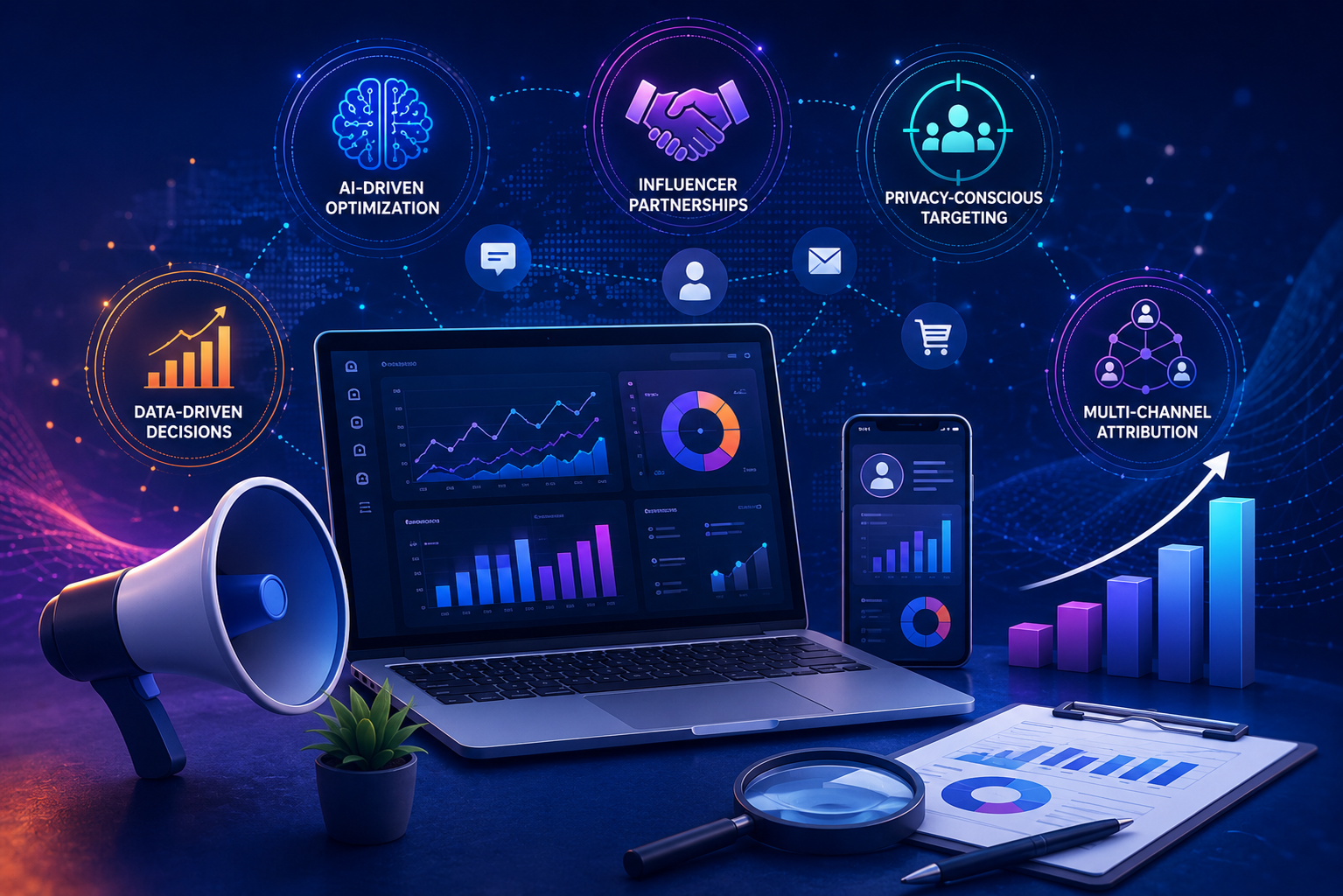
Performance marketing is evolving faster than ever. The combination of artificial intelligence, changing consumer behavior, privacy regulations, creator-led commerce, and fragmented digital channels has fundamentally changed how brands acquire and retain customers.
In 2026, marketers are no longer focused only on clicks and impressions. They are optimizing for profitability, customer lifetime value, cross-channel engagement, and privacy-safe personalization.
Several trends are shaping this transformation:
- AI-driven campaign optimization
- Performance-focused influencer partnerships
- Multi-channel attribution and measurement
- Privacy-conscious targeting strategies
- First-party data ecosystems
- Cross-platform customer journeys
According to multiple industry reports from Later, eMarketer, CreatorIQ, and other marketing research firms, brands are increasing investment in AI-assisted marketing systems and creator partnerships while moving away from outdated last-click attribution models.
This article breaks down the most important performance marketing trends of 2026 in practical, easy-to-understand language with examples, implementation tips, and real-world insights.
1. AI-Driven Optimization Is Becoming the Core of Performance Marketing
Winay Bari’s POV: AI is no longer optional in performance marketing. Brands that still rely entirely on manual optimization are already losing efficiency to competitors that use predictive automation and machine learning. However, the real competitive advantage does not come from simply using AI tools. It comes from combining AI speed with strong human creativity, brand positioning, and strategic judgment.
Artificial intelligence is no longer an experimental add-on. It has become the operational engine behind modern performance marketing.
Today’s AI systems help marketers:
- Optimize bidding in real time
- Predict customer intent
- Personalize ad creative
- Automate audience segmentation
- Forecast campaign performance
- Improve conversion rates
- Reduce wasted ad spend
Major advertising platforms like Google Ads, Meta Ads, TikTok Ads, LinkedIn, and Amazon Ads now rely heavily on machine learning algorithms.
Why AI Matters More in 2026
Consumer journeys have become too complex for manual optimization.
A single customer may:
- Discover a product on Instagram
- Watch a YouTube review
- Search on Google
- Read Reddit discussions
- Click a retargeting ad
- Purchase through a mobile app
AI helps marketers analyze thousands of data points instantly and make decisions faster than human teams alone.
AI Ad Optimization in Practice
Imagine an online fitness apparel brand running ads across Meta and Google.
Without AI:
- The marketing team manually adjusts bids every few days
- Ads target broad audiences
- Budget allocation depends on guesswork
With AI-driven optimization:
- The system identifies high-converting audience segments automatically
- Ads are shown at the best times of day
- Underperforming creatives are paused instantly
- Budget shifts toward high-performing campaigns in real time
- Personalized product recommendations appear dynamically
Result:
- Lower cost per acquisition (CPA)
- Higher return on ad spend (ROAS)
- Faster campaign scaling
What the Data Shows
Recent industry research indicates that AI-assisted marketing campaigns are delivering measurable gains in efficiency and engagement.
Research published later in 2025 found that 77% of brands reported improved campaign performance using AI-assisted influencer and advertising workflows. The same report showed growing adoption of AI for targeting, reporting, and content optimization.
Other reports also suggest that AI-powered attribution and conversion modeling are improving performance in privacy-focused environments where tracking data is more limited.
Practical Tips for Marketers
Start with One AI Workflow
Do not try to automate everything at once.
Begin with:
- Automated bidding
- Dynamic creative optimization
- AI audience expansion
- Email subject line testing
Feed AI Better Data
AI systems perform best when connected to:
- CRM data
- Purchase history
- Customer lifetime value data
- First-party behavioral signals
Focus on Human + AI Collaboration
AI should enhance strategy, not replace it.
Human marketers still provide:
- Brand positioning
- Emotional storytelling
- Creative direction
- Ethical judgment
Monitor AI Bias and Accuracy
My Verdict on AI-Driven Optimization
AI-powered performance marketing is becoming the operational standard for modern growth teams. The marketers seeing the strongest results are not replacing human teams with automation — they are using AI to improve speed, targeting precision, testing efficiency, and budget allocation while maintaining human oversight and creative direction.
Always review:
- Audience exclusions
- Creative outputs
- Budget allocation patterns
- Brand safety issues
2. Influencer Partnerships Are Becoming Performance Channels
Winay Bari’s POV: Influencer marketing is shifting from a branding experiment into a measurable revenue channel. In my view, the biggest mistake brands still make is chasing large follower counts instead of focusing on audience trust and conversion potential. Smaller creators with authentic communities often outperform celebrity influencers in real business outcomes.
Influencer marketing has evolved far beyond brand awareness campaigns.
In 2026, creator partnerships are increasingly tied to measurable business outcomes such as:
- Sales
- Leads
- App installs
- Subscription growth
- Affiliate revenue
- Customer retention
This shift has transformed influencer marketing into a major performance marketing channel.
The Rise of Performance Creators
Brands are moving away from vanity metrics like follower count.
Instead, marketers now prioritize:
- Engagement quality
- Conversion rates
- Audience trust
- Content relevance
- Community loyalty
Micro-influencers and mid-tier creators are becoming especially valuable because they often deliver stronger engagement and lower acquisition costs.
Performance Influencer Campaign
A skincare company partners with five beauty creators.
Instead of paying only flat sponsorship fees, the brand uses:
- Unique discount codes
- Affiliate links
- Revenue-sharing agreements
- UTM tracking links
One creator with 25,000 followers generates:
- 4,000 website visits
- 320 purchases
- A 5x return on ad spend
Meanwhile, a celebrity influencer with 2 million followers generates fewer conversions despite higher reach.
This demonstrates why performance-focused influencer marketing now emphasizes trust and audience relevance over pure audience size.
Long-Term Partnerships Are Winning
Research from influencer marketing platforms in 2025 showed brands increasingly favoring long-term creator relationships instead of one-off campaigns.
Why?
Audiences respond better when creators consistently use and discuss products over time.
Long-term creator relationships help brands:
- Build credibility
- Improve audience trust
- Increase repeat exposure
- Generate more authentic content
- Lower content production costs
AI Is Also Changing Influencer Marketing
AI tools now help brands:
- Identify creators with high conversion potential
- Predict campaign ROI
- Analyze audience authenticity
- Detect fake followers
- Automate reporting
- Match creators with target demographics
However, marketers are also becoming cautious about fully AI-generated influencers due to authenticity concerns.
Practical Tips for Marketers
Prioritize Audience Fit Over Reach
A smaller creator with a highly engaged niche audience often outperforms celebrity-scale accounts.
Measure Beyond Likes
Track:
- Revenue
- Lead generation
- Email signups
- Retention
- Repeat purchases
- Customer lifetime value
Repurpose Creator Content
High-performing creator content can also be reused in:
- Paid social ads
- Landing pages
- Email campaigns
- Product pages
- Retargeting campaigns
Build Creator Systems, Not One-Off Campaigns
My Verdict on Influencer Partnerships
Performance-based influencer marketing is becoming one of the most cost-effective acquisition channels for many consumer brands. Long-term creator partnerships, affiliate-driven compensation models, and authentic content are outperforming traditional polished advertising in many industries.
Develop ongoing creator programs with:
- Performance dashboards
- Affiliate structures
- Creative guidelines
- Reporting systems
3. Multi-Channel Attribution Is Replacing Last-Click Thinking
Multi-channel attribution is rapidly replacing outdated last-click attribution models as customer journeys become more fragmented across digital platforms. In today’s performance marketing ecosystem, a customer may first discover a brand through a TikTok creator, later search for reviews on Google, engage with Instagram ads, subscribe to an email newsletter, and finally convert through a retargeting campaign. Traditional last-click attribution gives full credit only to the final interaction before purchase, which creates misleading performance insights and undervalues awareness and nurturing channels. Multi-channel attribution solves this problem by distributing conversion credit across multiple touchpoints, helping marketers better understand how different platforms contribute throughout the customer journey. Modern attribution models, such as linear attribution, time-decay attribution, position-based attribution, and AI-driven data attribution, provide a more balanced view of performance. According to Google Analytics 4 and several industry reports from eMarketer and Gartner, businesses adopting advanced attribution systems are improving budget efficiency and optimizing cross-platform campaign performance more effectively than brands relying solely on last-click reporting.
Winay Bari’s POV: In my view, attribution is no longer just an analytics feature — it has become a strategic growth framework. Brands that fail to understand customer journey complexity often overspend on bottom-funnel advertising while underestimating the influence of content marketing, influencer campaigns, and upper-funnel engagement channels. Modern consumers interact with brands across multiple devices and platforms before purchasing, making holistic attribution essential for sustainable growth.
Practical Tips for Marketers
Build Attribution Around Business Goals
Do not treat attribution as only a reporting dashboard.
Your attribution framework should align directly with:
- Revenue growth
- Customer acquisition costs
- Retention goals
- Profitability metrics
- Lifetime value targets
Marketers who focus only on platform-reported ROAS often miss the broader business picture.
Prioritize Cross-Platform Visibility
Modern customers rarely convert through a single channel.
Use integrated analytics systems that help connect:
- Social media engagement
- Paid advertising
- Organic search
- Email nurturing
- Influencer traffic
- Website behavior
This creates a more accurate view of customer journeys.
Educate Internal Teams
Many executives still rely heavily on simplified attribution reports.
Marketing leaders should actively educate stakeholders about:
- Assisted conversions
- Attribution limitations
- Incrementality testing
- Customer journey complexity
- Upper-funnel influence
Better internal understanding leads to better strategic decisions.
Balance Short-Term and Long-Term Metrics
Not every channel delivers immediate conversions.
Channels such as:
- YouTube
- Podcasts
- Influencer collaborations
- SEO content
- Brand campaigns
often create long-term demand generation rather than instant purchases.
Strong attribution systems help marketers avoid undervaluing these growth drivers.
Use Attribution for Creative Optimization
Attribution should not only guide media buying.
It should also improve:
- Messaging strategy
- Creative formats
- Content sequencing
- Audience engagement
- Funnel progression
For example, marketers may discover that educational video content performs better during awareness stages while testimonials perform better during conversion stages.
My Verdict on Multi-Channel Attribution
Businesses that modernize their attribution strategies early will gain stronger visibility into customer behavior, make smarter investment decisions, improve ROI measurement, and create more sustainable long-term growth in increasingly privacy-focused digital ecosystems.
Multi-channel attribution is no longer just a reporting mechanism — it is becoming a strategic growth intelligence system for modern businesses.
Brands that understand the complete customer journey can allocate budgets more effectively, improve campaign efficiency, reduce wasted ad spend, and identify the channels that genuinely influence buying behavior across awareness, consideration, and conversion stages.
The future of attribution will increasingly rely on:
- AI-powered predictive modeling
- First-party customer data ecosystems
- Incrementality testing
- Media Mix Modeling (MMM)
- Privacy-safe analytics frameworks
At the same time, marketers must recognize that attribution will never be perfectly precise. Customer journeys are emotional, fragmented, cross-device, and constantly evolving.
Instead of chasing “perfect attribution,” successful brands will build adaptable measurement systems that combine:
- Quantitative analytics
- Behavioral insights
- Customer feedback
- Creative performance analysis
- Long-term customer value tracking

Leave a Reply