
Helping marketers build AI-first growth systems that drive measurable business outcomes—not just more content.
Content marketing has evolved far beyond writing blogs and publishing social media posts. Today’s audiences consume information through short-form videos, product explainers, educational content, customer stories, webinars, and AI-generated visuals. Video has become the highest-performing content format across almost every digital platform.
The challenge is that producing quality videos traditionally required expensive software, professional editors, voice artists, and significant production time. Artificial intelligence has fundamentally changed that equation.
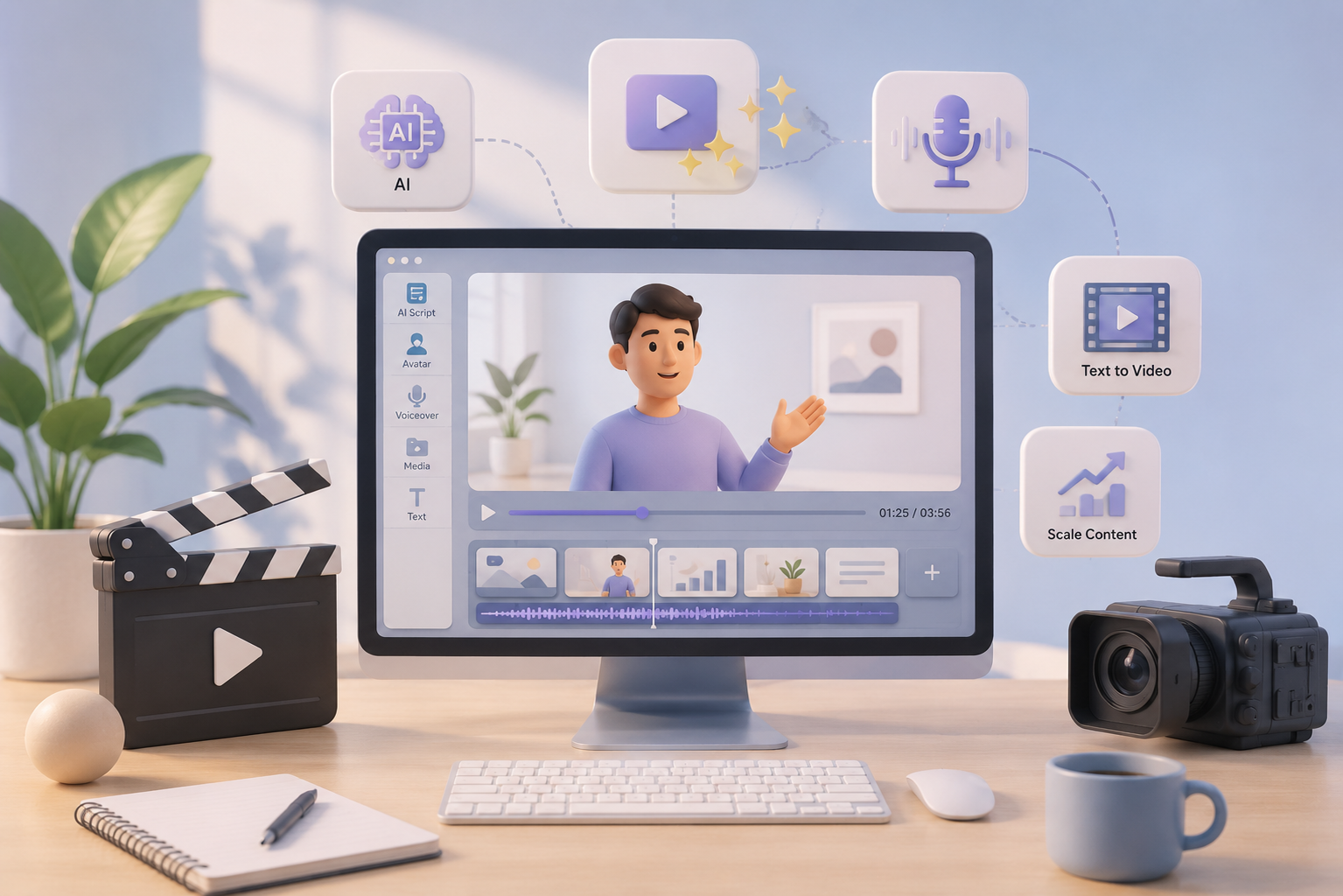
Modern AI video generators allow marketers to create polished videos in minutes rather than days. They automate scripting, scene generation, voiceovers, subtitles, avatars, translations, and editing—enabling lean marketing teams to publish consistently without compromising quality.
However, the explosion of AI video tools has created a new problem: choosing the right platform. Every vendor claims to be the fastest, smartest, or most realistic. In practice, each excels in different scenarios.
In this guide, I compare the best AI video generators for content marketing based on real-world marketing use cases rather than marketing hype. Whether you’re building YouTube content, LinkedIn thought leadership, paid ads, customer onboarding videos, or product explainers, you’ll understand which platform delivers the greatest return on investment.
Why AI Video Matters More Than Ever
Consumer attention continues shifting toward video-first experiences.
Instead of reading a 2,000-word article, many users prefer watching a two-minute explanation.
Marketing teams are responding by creating:
- Product demonstrations
- Social media reels
- Educational tutorials
- Customer testimonials
- Webinar snippets
- Sales enablement videos
- Internal training content
- Personalized outreach videos
The bottleneck is no longer strategy.
It is production capacity.
AI removes that bottleneck.
Instead of asking, “Can we afford to make this video?” marketers can now ask, “Should this idea become a video?”
That shift dramatically changes content velocity.
How We Evaluated These Tools
Each platform was assessed across:
- Video quality
- Ease of use
- AI capabilities
- Template library
- Voice realism
- Avatar quality
- Editing flexibility
- Collaboration features
- Pricing
- Marketing use cases
- Scalability
Quick Comparison
| Tool | Best For |
|---|---|
| Synthesia | Corporate training & explainer videos |
| Runway | Creative storytelling & editing |
| Pika | Social media creatives |
| HeyGen | AI avatar marketing |
| Lumen5 | Blog-to-video conversion |
| InVideo AI | Fast marketing videos |
| Veo | Cinematic AI video generation |
| Descript | Editing podcasts and videos |
| Canva AI | Social media marketing |
| CapCut AI | Reels & Shorts |
1. Synthesia — Best for Business Explainer Videos
Synthesia remains one of the strongest enterprise-grade AI video platforms.
It allows businesses to create presenter-led videos using realistic AI avatars speaking dozens of languages.
Ideal for:
- Product demos
- Customer onboarding
- Employee training
- SaaS tutorials
- Sales enablement
Pros
- Professional avatars
- Excellent multilingual support
- Easy updates
- Strong branding controls
Cons
Limited creative storytelling.
2. Runway — Best Overall Creative AI Video Platform
Runway is redefining AI-powered filmmaking.
Its generative capabilities allow marketers to create cinematic visuals from text prompts, making it particularly useful for brand campaigns, advertisements, and storytelling.
Best for:
- Brand films
- Campaign visuals
- Product launches
- Creative agencies
3. HeyGen — Best AI Avatar Platform
If your strategy revolves around founder branding or educational content, HeyGen offers one of the best avatar experiences available.
Marketing teams can generate hundreds of personalized videos without recording themselves repeatedly.
Perfect for:
- LinkedIn content
- Personalized sales outreach
- Product education
- Founder-led marketing
4. InVideo AI — Best for Fast Content Marketing
InVideo AI is designed specifically for marketers.
Simply enter a prompt, and it generates:
- Script
- Scenes
- Voiceover
- Stock footage
- Music
- Captions
For teams publishing daily content, speed becomes its greatest advantage.
5. Lumen5 — Best for Repurposing Blog Content
Lumen5 converts existing blog posts into engaging videos.
This makes it particularly valuable for SEO teams looking to extend the lifespan of high-performing articles.
Internal Link Opportunity:
After publishing a long-form guide, marketers can repurpose it into short videos and link readers to your article on Best AI Tools for Small Businesses in 2026 for a broader AI toolkit.
6. Canva AI
Canva continues evolving into an all-in-one creative suite.
Its AI-powered Magic Studio allows marketers to generate videos alongside presentations, social posts, and graphics.
Ideal for:
- YouTube Shorts
7. Descript
Descript revolutionizes editing.
Instead of editing timelines, you edit text.
Perfect for:
- Podcasts
- Webinars
- Interviews
- YouTube videos
8. CapCut AI
CapCut dominates short-form content.
Its AI automatically creates:
- Captions
- Transitions
- Background removal
- Voiceovers
- Auto reframing
Perfect for creators publishing multiple Shorts every day.
9. Pika
Pika focuses on fun, creative AI-generated animations and highly engaging social media content.
Excellent for viral marketing.
10. Google Veo
Google Veo represents the next generation of cinematic AI video generation.
Although aimed more at creators and enterprises today, it signals where marketing content is headed—high-quality, prompt-driven production with realistic motion and lighting.
Which Tool Should You Choose?
| Goal | Recommended Tool |
|---|---|
| Corporate Training | Synthesia |
| LinkedIn Videos | HeyGen |
| Blog Repurposing | Lumen5 |
| Creative Ads | Runway |
| Fast Marketing Videos | InVideo AI |
| Reels & Shorts | CapCut |
| Podcast Editing | Descript |
| Design Teams | Canva AI |
Building an AI Video Workflow
The most successful marketing teams don’t rely on one AI platform. They build integrated workflows.
A practical workflow looks like this:
- Use ChatGPT (or another LLM) for research and scripting.
- Generate visuals with Runway or Veo.
- Create presenter-led explainers with HeyGen or Synthesia.
- Edit and polish in Descript or CapCut.
- Schedule distribution using automation tools.
This aligns with the AI-first operational model discussed in Best Automation Tools for Solo Workers in 2026.
Likewise, as AI increasingly powers campaign optimization and creative production, it complements the trends outlined in Performance Marketing Trends in 2026.
Common Mistakes Marketers Make
- Choosing tools based solely on AI novelty instead of business outcomes.
- Producing videos without a content distribution strategy.
- Ignoring brand consistency across AI-generated assets.
- Treating AI as a replacement for strategic thinking rather than a force multiplier.
- Publishing large volumes of low-value videos without measuring engagement or conversions.
Final Verdict
AI video generators are no longer experimental tools—they are becoming core components of the modern content marketing stack.
The competitive advantage doesn’t come from simply using AI. It comes from integrating AI into a repeatable content system that combines strategy, creativity, and distribution.
From my perspective, marketers should resist the temptation to chase every new model or feature. Instead, identify the formats your audience responds to, select the tools that best support those formats, and build workflows that can scale without sacrificing quality.
In the coming years, the organizations that win won’t necessarily produce the most videos. They’ll produce the most relevant videos, backed by intelligent systems and measurable business outcomes.

Leave a Reply