
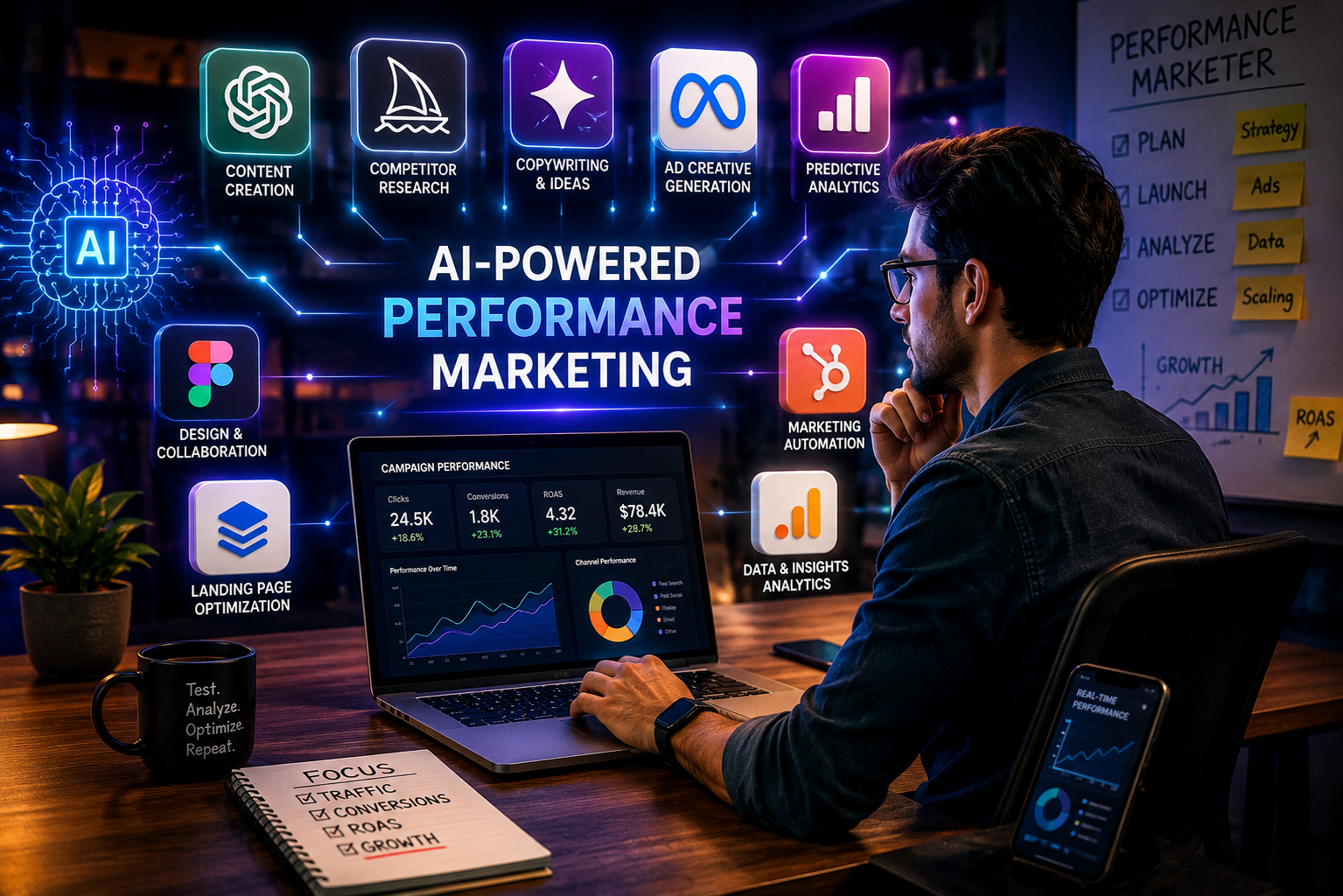
Artificial Intelligence (AI) has fundamentally transformed the digital marketing landscape. What was once limited to basic automation and rule-based optimization has evolved into intelligent systems capable of predicting user behavior, generating creative assets, optimizing bids, analyzing customer journeys, and uncovering growth opportunities at scale.
For performance marketers, AI is no longer a competitive advantage—it is a necessity.
Whether you’re managing paid search campaigns, social media advertising, programmatic media buying, affiliate marketing, or conversion rate optimization, AI-powered tools can significantly improve efficiency, reduce manual workload, and increase return on ad spend (ROAS).
In this comprehensive guide, we’ll explore the best AI tools for performance marketers in 2026, their key features, use cases, advantages, and how they can help marketing teams achieve measurable business outcomes.
What Are AI Tools for Performance Marketing?
AI tools for performance marketing are software platforms that use machine learning, predictive analytics, natural language processing (NLP), and automation to improve marketing performance.
These tools help marketers:
- Automate campaign management
- Optimize ad targeting
- Generate ad creatives
- Improve conversion rates
- Analyze customer behavior
- Personalize customer experiences
- Forecast campaign outcomes
- Reduce acquisition costs
The goal is simple: maximize results while minimizing manual effort.
Why Performance Marketers Need AI in 2026
The digital advertising ecosystem has become increasingly complex.
Marketers must manage:
- Multiple advertising platforms
- Rising acquisition costs
- Privacy regulations
- Attribution challenges
- Large datasets
- Faster campaign cycles
AI addresses these challenges by processing massive amounts of data in real time and making optimization decisions faster than any human team could.
Key benefits include:
Improved Campaign Efficiency
AI can automate repetitive tasks such as bid management, audience segmentation, budget allocation, and reporting.
Better Personalization
Modern AI platforms deliver highly personalized experiences across customer touchpoints.
Faster Decision-Making
Predictive analytics identify opportunities before competitors react.
Increased ROI
AI-driven optimization often leads to better conversion rates and reduced cost-per-acquisition (CPA).
AI marketing tools are evolving rapidly, and new platforms appear almost every month. As a performance marketer, choosing the wrong tool can result in wasted budget, poor campaign performance, and unnecessary operational complexity.
To create this guide, I evaluated leading AI marketing tools based on their practical applications for performance marketing teams rather than vendor claims alone.
My assessment framework focused on five critical areas:
- Performance marketing functionality
- Automation capabilities
- Ease of implementation
- Integration with advertising platforms
- Potential return on investment
The recommendations in this guide are based on industry adoption, feature maturity, real-world use cases, and how effectively each platform solves common performance marketing challenges.
How I’ve Evaluated These AI Tools
Not all AI tools are built for performance marketers.
Some excel at content creation, while others specialize in attribution, campaign optimization, or conversion rate improvement.
Each tool was evaluated using the following criteria:
| Evaluation Criteria | Weight |
|---|---|
| Marketing Impact | 30% |
| Automation Capability | 20% |
| Ease of Use | 15% |
| Integration Ecosystem | 15% |
| Reporting & Analytics | 10% |
| Cost Efficiency | 10% |
Marketing Impact
Can the platform directly improve performance metrics such as:
- ROAS
- CPA
- Conversion Rate
- Revenue
- Lead Generation
Automation Capability
How much manual work can the tool eliminate?
Ease of Use
Can marketing teams implement and adopt the platform without significant technical expertise?
Integration Ecosystem
Does the platform connect with tools such as:
- Google Ads
- Meta Ads
- Shopify
- HubSpot
- Salesforce
- GA4
Cost Efficiency
Does the expected business value justify the investment?
Quick Comparison Table
| Tool | Best For | Starting Price | Free Trial | Overall Rating |
| Google Ads AI | PPC Campaign Automation | Included in Google Ads | No | 9.8/10 |
| Meta Advantage+ | Social Advertising | Included in Meta Ads | No | 9.6/10 |
| ChatGPT | Content & Strategy | Subscription-Based | Yes | 9.7/10 |
| Jasper | Marketing Content | Paid | Yes | 9.2/10 |
| Surfer SEO | SEO Optimization | Paid | Limited | 9.1/10 |
| SEMrush | Competitive Intelligence | Paid | Yes | 9.4/10 |
| AdCreative.ai | Ad Creatives | Paid | Yes | 9.0/10 |
| Optimizely | CRO Testing | Enterprise | Demo | 9.3/10 |
| HubSpot AI | Marketing Automation | Paid | Yes | 9.2/10 |
| Triple Whale | eCommerce Attribution | Paid | Demo | 9.1/10 |
| Copy.ai | Workflow Automation | Paid | Yes | 8.9/10 |
| Midjourney | AI Visual Creation | Paid | No | 9.4/10 |
My Testing Framework
As a performance marketer, I evaluate every AI tool through one simple lens:
Will this tool generate more revenue, improve efficiency, or create a measurable competitive advantage?
During evaluation, I focus on:
Time Savings
How many hours can the platform save each month?
Performance Lift
Can it improve:
- CTR
- ROAS
- Conversion Rate
- Lead Quality
Scalability
Can the platform support campaigns across multiple channels and larger budgets?
Reliability
Can marketers trust the recommendations generated by the AI?
What I Look for Before Recommending an AI Tool
Many AI tools look impressive in product demos but fail in production environments.
Before recommending a platform, I look for:
✔ Strong customer adoption
✔ Consistent product updates
✔ Reliable support
✔ Practical business applications
✔ Measurable marketing outcomes
✔ Proven integration ecosystem
This helps separate genuinely useful AI solutions from tools driven primarily by marketing hype.
Who This Guide Is For
This guide is designed for:
- Performance Marketers
- PPC Specialists
- Growth Marketers
- SEO Professionals
- Media Buyers
- Marketing Agencies
- eCommerce Brands
- SaaS Companies
- Digital Marketing Consultants
Whether you’re managing $1,000 per month or $1 million per month in advertising spend, these tools can help improve efficiency and performance.
Let’s deep dive every tool in detail covering key features, benefits, some use cases and my recommendation
1. Google Ads AI
Best For
Search advertising and campaign automation.
Key Features
- Smart Bidding
- Performance Max Campaigns
- Dynamic Search Ads
- Predictive Conversion Modeling
- Audience Expansion
Benefits
Google Ads AI evaluates billions of signals in real time to optimize bids, audiences, placements, and conversions.
Real-World Use Case
A D2C skincare brand spending $50,000 monthly on Google Ads was struggling to scale while maintaining profitability. By implementing Smart Bidding using Target ROAS and migrating high-performing campaigns to Performance Max, the brand increased conversion volume by 37% while reducing cost per acquisition by 18% over a three-month period.
My Opinion
“In my experience, Google Ads AI delivers the strongest results when marketers provide high-quality conversion data. Too many advertisers attempt to outsmart Google’s machine learning. The better strategy is to focus on accurate tracking, audience signals, and creative assets while allowing AI to handle bid optimization.”
2. Meta Advantage+
Best For
Facebook and Instagram campaign optimization.
Key Features
- Automated Audience Discovery
- Dynamic Creative Optimization
- AI-Powered Placement Selection
- Budget Automation
Benefits
Meta’s machine learning identifies high-intent audiences across billions of user interactions.
Real-World Use Case
An eCommerce fashion retailer used Advantage+ Shopping Campaigns during a seasonal sale. The platform automatically identified high-value audience segments and generated a 29% increase in ROAS compared to manually managed campaigns.
My Opinion
“Meta’s AI has become remarkably effective at finding customers beyond traditional interest targeting. Performance marketers who continue relying solely on manual audience segmentation are often limiting campaign scale.”
3. ChatGPT
Best For
Content generation, campaign planning, and marketing analysis.
Key Features
- Ad Copy Creation
- Audience Research
- Landing Page Drafting
- Reporting Automation
- Keyword Clustering
Benefits
Accelerates content production and strategic execution.
Real-World Use Case
A SaaS company used ChatGPT to generate over 100 ad variations for Google Ads and LinkedIn campaigns. This reduced copywriting time by 80% and helped identify messaging themes that improved click-through rates by 22%.
My Opinion
“ChatGPT has become one of the most valuable productivity tools in my marketing stack. The greatest value isn’t replacing marketers—it’s eliminating repetitive tasks so teams can focus on strategy and experimentation.”
4. Jasper AI
Best For
Scalable content production.
Key Features
- AI Copywriting
- Brand Voice Controls
- Marketing Templates
- Campaign Content Creation
Benefits
Maintains brand consistency while increasing content velocity.
Real-World Use Case
A B2B software company used Jasper to generate blog outlines, email sequences, and ad copy across multiple product lines. Content production increased by 300% without adding additional writers.
My Opinion
“Jasper excels when organizations require consistent messaging across channels. It is particularly useful for growing marketing teams managing large content volumes.”
5. Surfer SEO
Best For
SEO content optimization.
Key Features
- Content Scoring
- NLP Recommendations
- SERP Analysis
- Keyword Coverage
Benefits
Improves content relevance and ranking potential.
Real-World Use Case
A finance website optimized 50 existing articles using Surfer SEO recommendations and increased organic traffic by 64% within six months.
My Opinion
“Surfer should be used as an optimization framework rather than a content-writing replacement. The highest-performing pages combine Surfer’s recommendations with genuine subject-matter expertise.”
6. SEMrush AI Toolkit
Best For
Competitive research and search intelligence.
Key Features
- Competitor Analysis
- Keyword Research
- Traffic Intelligence
- PPC Insights
Benefits
Provides actionable market intelligence.
Real-World Use Case
A legal services firm identified several high-converting keywords competitors were targeting. By expanding their PPC strategy, they increased qualified lead volume by 41%.
My Opinion
“SEMrush remains one of the most complete intelligence platforms available. Before launching any campaign, I recommend understanding competitor positioning and search demand through reliable data.”
7. AdCreative.ai
Best For
AI-generated ad creatives.
Key Features
- Banner Generation
- Creative Scoring
- AI Design Suggestions
- Performance Prediction
Benefits
Accelerates creative testing.
Real-World Use Case
A dropshipping brand generated 50 new creative variations in a single day and discovered a winning design that improved CTR by 34%.
My Opinion
“Creative fatigue is one of the biggest performance killers in paid social. AdCreative.ai enables teams to test more ideas faster and identify winners before budgets are wasted.”
8. Optimizely
Best For
Conversion rate optimization.
Key Features
- A/B Testing
- Multivariate Testing
- Personalization
- Experiment Management
Benefits
Improves website conversion performance.
Real-World Use Case
A SaaS company tested different pricing page layouts and increased trial signups by 21% using Optimizely’s experimentation framework.
My Opinion
“Many businesses focus entirely on traffic acquisition while ignoring conversion optimization. Improving conversion rates often delivers faster revenue growth than increasing ad spend.”
9. HubSpot AI
Best For
Marketing automation and CRM-driven growth.
Key Features
- Lead Scoring
- Workflow Automation
- Content Generation
- Customer Segmentation
Benefits
Connects marketing efforts directly to revenue outcomes.
Real-World Use Case
A B2B company automated lead nurturing workflows and increased sales-qualified leads by 35% while reducing manual marketing operations.
My Opinion
“The strongest marketing teams align acquisition, nurturing, and sales processes. HubSpot’s AI capabilities help create a unified growth engine.”
10. Triple Whale
Best For
eCommerce analytics and attribution.
Key Features
- Attribution Modeling
- Revenue Forecasting
- Customer Lifetime Value Analysis
- Marketing Dashboards
Benefits
Provides clearer visibility into marketing effectiveness.
Real-World Use Case
A Shopify brand discovered that TikTok campaigns were influencing purchases attributed to other channels. Triple Whale revealed hidden revenue contributions and improved budget allocation.
My Opinion
“Attribution is one of the biggest challenges facing performance marketers. Platforms like Triple Whale provide a more realistic view of how marketing channels contribute to growth.”
11. Copy.ai
Best For
Marketing workflow automation.
Key Features
- AI Writing
- Workflow Automation
- Sales Prospecting
- Campaign Planning
Benefits
Improves operational efficiency.
Real-World Use Case
A startup marketing team reduced campaign preparation time by 50% through automated content workflows and prospect research.
My Opinion
“Copy.ai is evolving beyond content generation. Its workflow automation capabilities are particularly valuable for lean teams managing multiple growth initiatives.”
12. Midjourney
Best For
AI image generation.
Key Features
- High-Quality Visual Creation
- Creative Concept Development
- Advertising Assets
Benefits
Reduces dependency on traditional design resources.
Real-World Use Case
A consumer electronics brand used Midjourney to create product campaign concepts before investing in expensive photoshoots, cutting creative development costs significantly.
My Opinion
“Visual storytelling remains a major driver of advertising performance. Midjourney allows marketers to rapidly prototype ideas and validate creative directions before committing production budgets.”
My Top 5 AI Tools for Performance Marketers
If I were building a modern marketing stack today, these would be my priorities:
1. ChatGPT
Best overall productivity tool for marketers.
2. Google Ads AI
Most impactful platform for paid search optimization.
3. Meta Advantage+
Essential for scaling paid social campaigns.
4. SEMrush
Best competitive intelligence platform.
5. Triple Whale
Best attribution solution for eCommerce brands.
Together, these tools cover strategy, execution, optimization, reporting, and scaling.
About the Author
Winay Bari is a digital marketing strategist specializing in SEO, performance marketing, paid media, analytics, and AI-powered growth strategies.
Over the years, he has worked with businesses across multiple industries to improve customer acquisition, increase organic visibility, optimize paid advertising campaigns, and implement data-driven marketing systems.
His areas of expertise include:
- Search Engine Optimization (SEO)
- Google Ads
- Meta Advertising
- Conversion Rate Optimization
- Marketing Analytics
- AI-Powered Marketing
- Customer Acquisition Strategy
Through hands-on experience with modern marketing technologies, Winay helps organizations identify scalable growth opportunities while maximizing return on marketing investment.

Leave a Reply