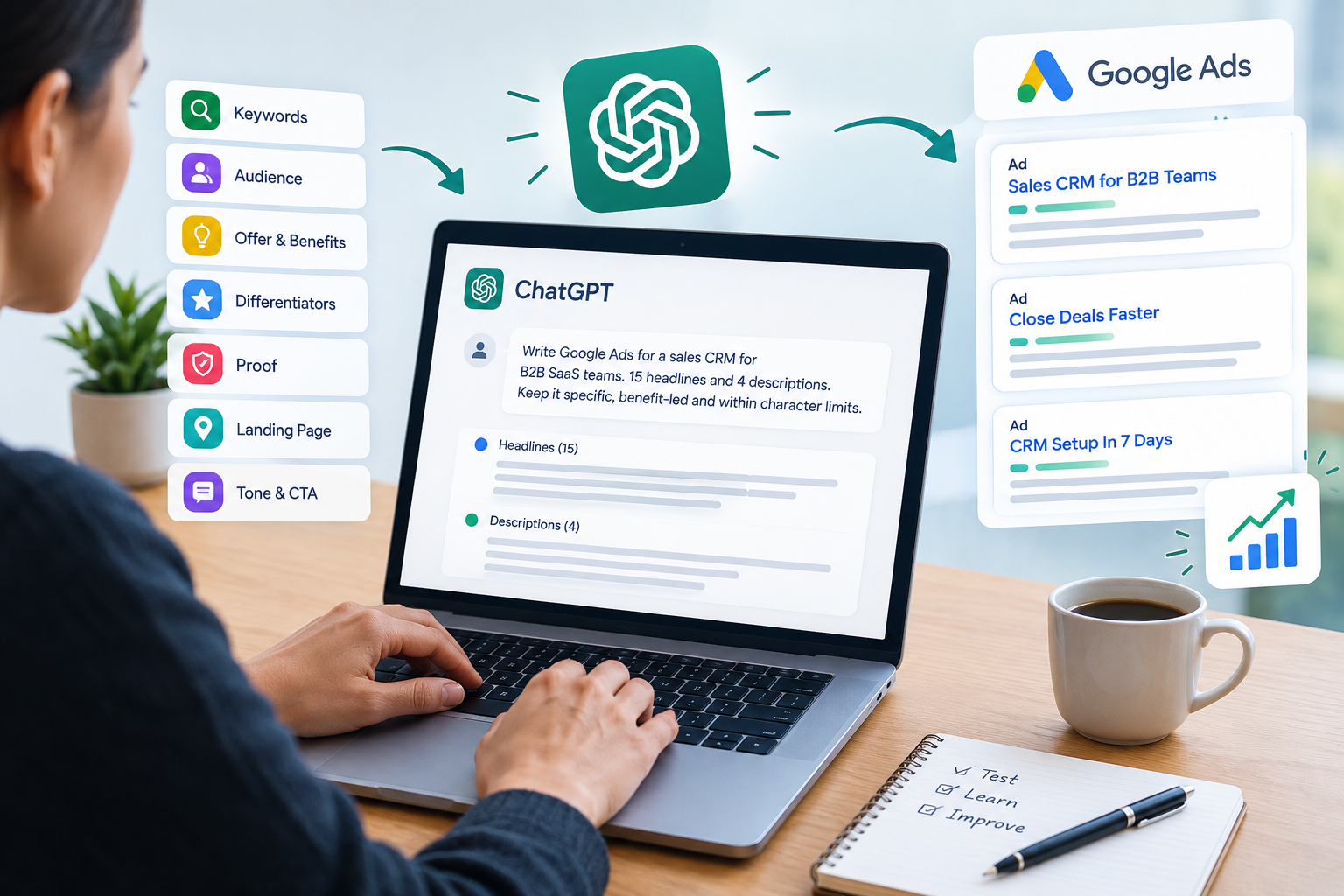
Give ChatGPT the information a human copywriter would need: the keyword, search intent, audience, offer, benefits, differentiators, proof, landing-page message, brand tone, character limits, and compliance constraints.
Then ask it to generate multiple messaging angles, remove repetition, flag claims that need verification, and rewrite the strongest options for your ad platform.
The key idea is simple:
Use ChatGPT to create and refine more ideas faster. Use your marketing judgment and campaign data to decide what gets published and tested.
For Google Ads, responsive search ads can contain up to 15 headlines and 4 descriptions. Headline fields support up to 30 characters, while description fields support up to 90 characters. Google also says assets can be combined in different orders, so each asset should make sense on its own and in combination.
What makes PPC ad copy different?
PPC ad copies are short, but it is not simple.
A search ad has to match intent, communicate the offer, show a useful benefit, differentiate the business, and give the user a reason to click—all inside tight space limits.
A useful way to think about PPC copy is:
Intent + Problem + Offer + Proof + Next Step
Suppose you sell bookkeeping software.
Weak:
Powerful Bookkeeping Software
Grow Your Business Today
Better:
Bookkeeping Software
Automate Monthly Reconciliation
Built For Small Businesses
The second version gives the searcher concrete information.
Google’s current Search Ads guidance recommends natural, informative copy, keyword relevance, benefit-led messaging, audience hooks, and specific calls to action rather than generic language.
ChatGPT is particularly useful for the volume problem.
You might normally brainstorm 10 headlines. AI can generate dozens of directions in seconds. Your job is to turn those raw ideas into accurate, useful, testable advertising.
Why vague prompts produce bad PPC copy
Consider this prompt:
Write Google Ads for a CRM.
You will probably get familiar marketing phrases such as:
“Boost Productivity.”
“Powerful CRM.”
“Grow Faster.”
The problem is not that the sentences are grammatically bad. The problem is that they could describe thousands of products.
Now give ChatGPT context:
Write Google Search ad copy for a CRM built for 20–100-person B2B SaaS companies. Primary keyword: sales CRM. Main differentiator: implementation in 7 days with migration support. Proof: 1,200+ companies onboarded. CTA: Book a demo. Create 15 headlines under 30 characters and 4 descriptions under 90 characters. Do not invent claims.
That prompt gives the model something real to work with.
OpenAI recommends clear, specific prompts that include enough context, followed by iterative refinement.
Think of it like briefing a junior copywriter:
More useful inputs → more relevant options → less editing.
Read my blog on – A Founder’s SaaS Landing Page Optimization Checklist for Better Conversions
The PPC Copy Matrix: 8 angles to ask ChatGPT for
Do not ask AI for “15 catchy headlines.” Ask for a planned mix of messages.
| Angle | What to communicate | Example |
|---|---|---|
| Keyword | Match the search | “Sales CRM Software” |
| Benefit | Desired outcome | “Close Deals Faster” |
| Pain | Current frustration | “Stop Chasing Leads” |
| Differentiator | Why you are different | “CRM Setup In 7 Days” |
| Proof | Credible evidence | “Used By 1,200+ Teams” |
| Audience | Who it is for | “CRM For SaaS Teams” |
| Objection | Reduce hesitation | “See Pricing Upfront” |
| CTA | Next action | “Book A Demo” |
This is better than generating 15 versions of the same sentence.
Google recommends multiple unique, diverse assets for responsive search ads and warns that repetitive headlines and descriptions can restrict useful combinations.
A practical ChatGPT workflow for PPC
1. Build a message brief
Before opening ChatGPT, collect:
- Primary keyword and close variants
- Search intent
- Audience
- Product or service
- Main benefit
- Key differentiators
- Offer or promotion
- Proof points
- Landing-page promise
- Brand voice
- CTA
- Character limits
- Claims or phrases to avoid
This becomes your reusable PPC context block.
2. Generate angles before final copy
Ask ChatGPT to identify customer pains, desired outcomes, objections, differentiators, and proof points first.
Try:
Based on this product and audience, identify the top 15 customer pains, 10 objections, 10 desired outcomes, and 10 reasons someone would choose this product. Separate facts from assumptions. Do not write ad copy yet.
This often produces better copy than immediately asking for headlines because you have explored the message territory first.
3. Generate more options than you need
For Google Search, a practical starting point is 8–10 strong headlines, with the option to build toward the full 15. Google’s current guidance specifically recommends at least 8–10 headlines and emphasizes unique content rather than repetition.
4. Filter aggressively
Delete copy that is:
- Generic
- Repetitive
- Unsupported
- Too clever to understand quickly
- Misaligned with the landing page
- Overloaded with keywords
5. Check combinations
Because responsive search ad assets may appear in different positions, do not judge a headline in isolation only. Put your first few headlines together and ask whether they still read naturally as a group. Google explicitly recommends considering how headlines work together.
6. Test with real data
Do not decide which ad is “best” because ChatGPT likes it more. Use campaign performance to evaluate actual user behavior.
Read my blog on: 5 Best ChatGPT Alternatives for Productivity in 2026 (Tested)
5 ChatGPT prompts for PPC ad copy
Prompt 1: The master Google Ads prompt
Act as a senior PPC copywriter.
Business: [BUSINESS]
Product/service: [PRODUCT]
Audience: [AUDIENCE]
Campaign goal: [LEADS/SALES/TRIALS]
Primary keyword: [KEYWORD]
Search intent: [INTENT]
Offer: [OFFER]
Benefits: [BENEFITS]
Differentiators: [DIFFERENTIATORS]
Proof: [PROOF]
Landing-page promise: [PROMISE]
CTA: [CTA]
Tone: [TONE]Create 15 unique headlines under 30 characters and 4 descriptions under 90 characters. Group headlines by keyword, benefit, pain, differentiator, proof, audience, objection, and CTA. Avoid clichés, keyword stuffing, unsupported superlatives, fake urgency, and invented claims. Flag anything that requires verification.
This is your core ChatGPT PPC ad copy prompt.
Prompt 2: Find the customer pain
Analyze this product and audience. Give me the 15 most important customer pains, 10 objections, 10 desired outcomes, and 10 reasons to believe. Separate documented facts from assumptions. Then suggest messaging angles for PPC ads.
Use this before copy generation. It forces the AI to explore the customer’s world rather than immediately producing slogans.
Prompt 3: Find competitor white-space
Here are competitor ads: [PASTE ADS]. Here is our product: [DETAILS]. Identify messaging territory they do not clearly own. Then write 20 PPC headlines around our documented differentiators. Do not attack competitors and do not create claims we cannot prove.
This is useful when your ads sound interchangeable with every competitor in the auction.
Prompt 4: Rewrite existing ads
Rewrite these PPC headlines for high-intent searchers comparing providers. Keep each under 30 characters. Make them more specific, benefit-led, and credible. Preserve factual claims unless you flag them for verification. Do not introduce new promises.
This turns ChatGPT into an editor rather than a blank-page generator.
Prompt 5: Critique the copy
Critique these ads for relevance, clarity, differentiation, proof, CTA, and landing-page alignment. Do not give an overall score or choose a winner. Identify the strongest elements, the biggest weaknesses, and revised versions within the original character limits.
The last prompt is particularly useful because it creates structured feedback without pretending AI can predict campaign performance.
Read my blog on: Performance Marketing Trends in 2026: What Marketers Need to Know
How to write better Google Ads headlines with ChatGPT
A practical 15-headline structure looks like this.
3 keyword headlines
Sales CRM Software
CRM For Sales Teams
B2B Sales CRM
3 benefit headlines
Close Deals Faster
Keep Leads Organized
See Your Pipeline Clearly
2 pain headlines
Stop Losing Warm Leads
Done With Spreadsheets?
2 differentiator headlines
CRM Setup In 7 Days
Built For SaaS Teams
2 proof headlines
Used By 1,200+ Teams
Trusted By Growing Firms
2 audience headlines
For B2B Sales Teams
For Growing SaaS Firms
1 CTA headline
Book A Demo
The exact claims must come from your actual business.
Google says including relevant keyword text in headlines can improve keyword relevance, while providing diverse assets gives the system more combinations to work with.
The objective is not to force the keyword into every line.
It is to create a set where relevance and variety coexist.
How to write Google Ads descriptions with ChatGPT
A useful formula is:
Benefit + Differentiator + Proof/Reassurance + CTA
For example:
Manage leads, follow-ups and pipeline in one place. Book a demo today.
Or:
Built for growing SaaS teams. Migrate your CRM and get live in 7 days.
Notice that neither description is trying desperately to be “creative.”
They are trying to be clear.
Ask ChatGPT for versions for different intent levels:
Research intent:
“Compare features and pricing.”
Solution-aware intent:
“Automate lead follow-up and pipeline management.”
High-intent search:
“Book a demo with our sales team.”
Branded search:
“Explore [Brand] plans, features and support.”
This approach creates useful variations instead of simple rewrites.
Use your landing page as the source of truth
One of the highest-value uses of ChatGPT for PPC is message validation.
Give it your landing-page copy and ask:
Extract every product feature, price, qualification, offer condition, proof point, and customer promise from this page. Put them into three groups: Verified Facts, Claims That Need Verification, and Missing Information. Use only Verified Facts to write the ad.
This reduces the risk of AI inventing attractive but unsupported marketing claims.
Google Ads requires advertising and destinations to be clear, relevant and professional, and its policies prohibit false, misleading, or unrealistic claims.
That creates a useful rule for AI-assisted PPC:
AI can draft the claim. A human must verify the claim.
How to stop ChatGPT from writing generic ad copy
Tell it what “generic” means.
For example:
Avoid phrases such as “unlock growth,” “game-changing,” “next-level,” “seamless,” “cutting-edge,” and “grow your business today” unless specifically justified. Every headline must contain at least one concrete element: keyword, audience, outcome, feature, proof, price, time-frame, or differentiator.
Now compare:
Generic:
“Powerful SEO Platform”
Specific:
“Track 200+ SEO Keywords”
Generic:
“Grow Your Business Today”
Specific:
“Get More Qualified Leads”
Generic:
“Affordable Insurance Plans”
Specific:
“Compare Health Plans Online”
Specificity is one of the easiest ways to reduce the “AI-written” feeling.
Add negative examples to your prompt
ChatGPT can also benefit from seeing what you do not want.
Try:
Bad: “Unlock Powerful Growth Today.”
Why bad: vague, cliché, no audience, no proof.Good direction: “CRM For SaaS Teams.”
Good direction: “CRM Setup In 7 Days.”
Good direction: “See Pricing Upfront.”Now generate new headlines at the same specificity level.
You are not just telling AI what to create.
You are giving it a definition of good copy for your account.
Use ChatGPT for PPC testing—not prediction
Suppose you want to test four messaging hypotheses:
Keyword-led:
“Sales CRM Software”
Benefit-led:
“Close Deals Faster”
Differentiator-led:
“CRM Setup In 7 Days”
Proof-led:
“Used By 1,200+ Teams”
The purpose is to create distinct hypotheses and learn from campaign data.
ChatGPT should not declare in advance which one will win.
After your campaign has actual performance data, you can give ChatGPT the results:
Here are our asset-level results: [DATA]. Group the results by messaging angle. Identify patterns, anomalies, and areas that need more data. Do not claim causality from small samples.
This is a much stronger use of AI than asking:
Which ad is the best?
The first approach supports experimentation. The second encourages false certainty.
Common ChatGPT PPC copy mistakes
Mistake 1: One-shot prompting
The first output is a draft, not necessarily the finished strategy. OpenAI recommends iterative refinement when working with prompts.
Mistake 2: Giving AI no differentiator
If you tell ChatGPT only that you sell “CRM software,” it has almost no unique information to work with.
Mistake 3: Letting AI invent proof
Never publish a customer count, percentage, award, ranking, guarantee, review, price, or performance claim that has not been verified.
Mistake 4: Optimizing for cleverness
A searcher should understand the offer quickly. A clever headline that obscures the product is not automatically good PPC copy.
Mistake 5: Ignoring platform rules
Google Ads policies cover prohibited content, prohibited practices, restricted content, and editorial/technical standards. AI-generated copy is still subject to those rules.
Mistake 6: Turning every asset into a synonym
Responsive search ads need meaningful variety. Repeating the same idea 15 times reduces the usefulness of multiple assets.
PPC ad copy quality checklist
Before publishing, ask:
Relevance: Does the ad match the keyword and search intent?
Clarity: Can a new visitor understand the offer immediately?
Specificity: Does the copy contain something concrete?
Differentiation: Is there a reason this business is different?
Proof: Is every factual claim verified?
CTA: Is the next step obvious?
Landing-page match: Does the page deliver what the ad promises?
Character count: Does every asset fit the format?
Variety: Do the assets express different ideas?
Compliance: Does the copy follow the platform’s policies?
This checklist is simple enough for a freelancer and rigorous enough for an in-house PPC team.
Build a PPC AI feedback loop
The best ChatGPT workflow becomes more valuable as your account generates data.
Create a swipe file containing your strongest:
- Headlines and descriptions
- Search terms
- Customer reviews
- Sales objections
- Lead-quality feedback
- Competitor messages
- Landing-page copy
- Offers
- Failed tests
- Policy issues
Then use that information to generate the next round of ideas.
A useful prompt is:
Here are our previous ads and performance notes. Identify recurring messaging patterns without claiming causation. Generate 30 new concepts that retain the strongest documented themes while introducing new angles.
The loop becomes:
Campaign data → Insight → New copy → Test → New data
That is a real AI-assisted PPC system.
Conclusion: Use ChatGPT as your PPC copy engine, not your PPC decision-maker
The biggest advantage of ChatGPT for PPC ad copy is not that it can write 15 headlines in seconds.
It is that you can explore many more messages, angles and iterations without multiplying manual work.
Use ChatGPT to:
Research messaging.
Generate variations.
Rewrite weak assets.
Find repetition.
Structure tests.
Analyze patterns.
Keep the human in charge of:
Positioning.
Truth and proof.
Offer strategy.
Compliance.
Testing decisions.
Business outcomes.
The winning workflow is not:
“AI writes my ads.”
It is:
Human strategy → AI-assisted ideation → Human verification → Live testing → Data-driven iteration
That is how to use ChatGPT for PPC ad copy without turning your account into a collection of generic AI phrases.
Sources
Google Ads Help — About responsive search ads.
Google Ads Help — Best practices for effective responsive search ads.
Google Ads Help — Create effective responsive search ads.
Google Ads Help — Ad Strength for responsive search ads.
OpenAI Help Center — Prompt engineering best practices for ChatGPT.
Google Ads Help — Editorial and advertising policies.
Frequently Asked Questions
Can ChatGPT write Google Ads?
Yes. ChatGPT can generate headlines, descriptions, variations, rewrites, messaging angles, and critiques. You still need to verify claims, character limits, landing-page alignment, and policy compliance.
What is the best ChatGPT prompt for Google Ads?
A strong prompt includes the audience, keyword, search intent, offer, benefits, differentiators, proof, landing-page context, CTA, tone, and platform constraints. OpenAI recommends clear, specific instructions with enough context and iterative refinement.
Can ChatGPT improve PPC conversion rates?
It can make ad production and iteration faster and help you explore more relevant messages. It cannot guarantee better conversion performance because results depend on the offer, audience, auction, landing page, competition, tracking, and other factors.
How many headlines should I create for a responsive search ad?
Google currently permits up to 15 headlines and 4 descriptions. Its current guidance recommends starting with at least 8–10 headlines and prioritizing unique, relevant assets.
Should ChatGPT choose my winning ad?
Use campaign data to evaluate performance. ChatGPT is more useful for generating hypotheses, organizing results, critiquing weak copy, and creating the next round of tests.
Can I paste ChatGPT output directly into Google Ads?
Treat the output as a draft. Check every factual claim, offer, price, product capability, spelling, character count, landing-page promise, and policy requirement before publishing. Google prohibits misleading or unrealistic claims.

Leave a Reply