
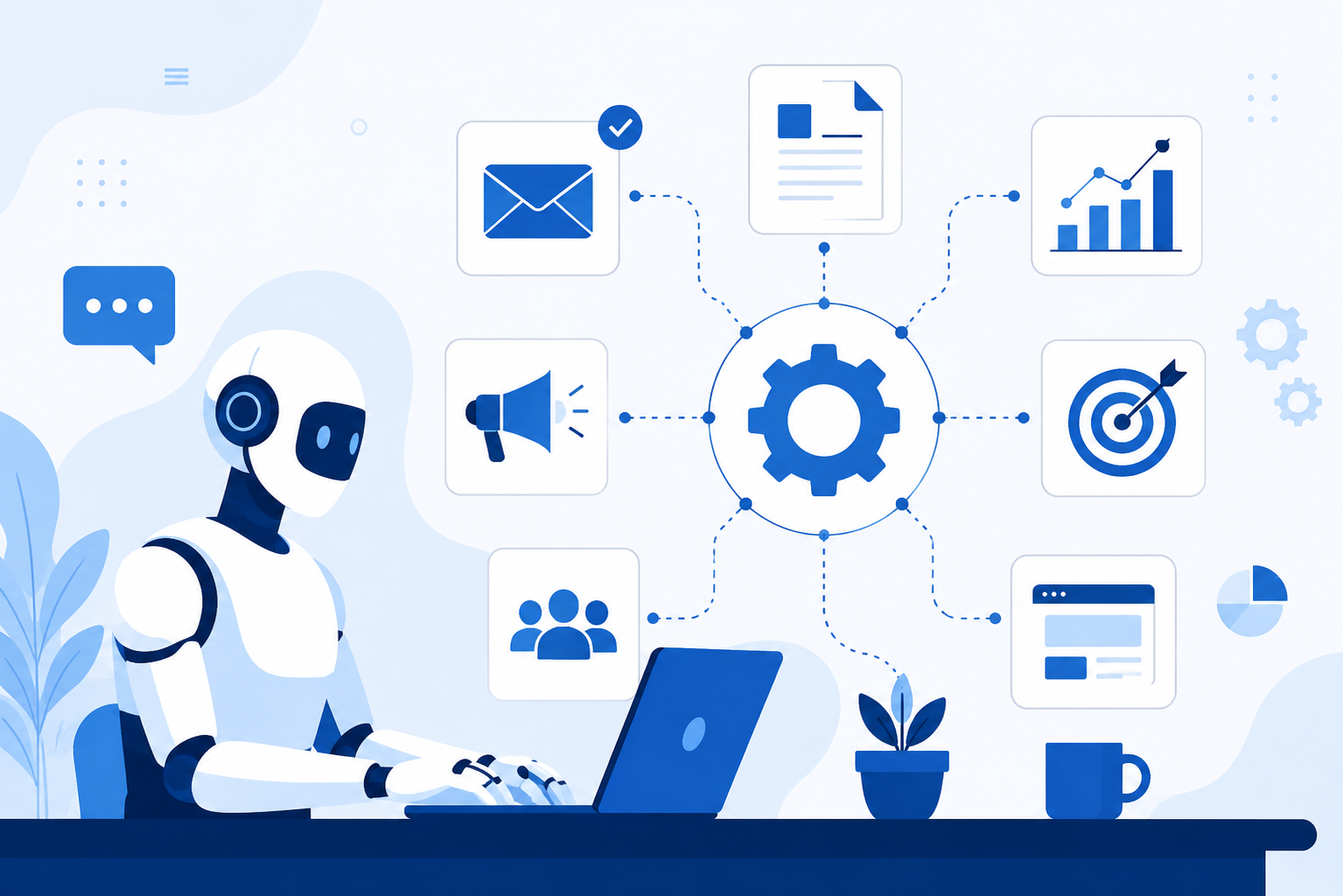
Marketing has always been a blend of creativity, strategy, and execution. While creativity and strategic thinking continue to define successful campaigns, a significant portion of modern marketing consists of repetitive workflows that consume valuable time and resources. From scheduling social media posts and sending email sequences to generating reports and segmenting audiences, marketers spend countless hours performing tasks that follow predictable patterns.
Artificial Intelligence (AI) is rapidly transforming this landscape. Businesses across industries are adopting AI-powered marketing tools to automate routine processes, improve efficiency, and free teams to focus on high-value activities. The question is no longer whether AI will impact marketing workflows—it already has. The real question is how extensively AI will replace repetitive marketing work and what marketers must do to stay ahead.
This article explores why AI will replace repetitive marketing workflows, the benefits driving this transformation, and how organizations can leverage AI to build smarter and more scalable marketing operations.
Understanding Repetitive Marketing Workflows
Before examining AI’s role, it is important to define what constitutes a repetitive marketing workflow.
A repetitive marketing workflow is any marketing task that follows predefined rules, patterns, or sequences with minimal need for human judgment. These activities are often manual, time-consuming, and prone to human error.
Common examples include:
- Email campaign scheduling
- Lead scoring and qualification
- CRM data entry
- Social media posting
- Marketing performance reporting
- Ad campaign optimization
- Keyword research aggregation
- Customer segmentation
- A/B testing administration
- Chatbot-based customer interactions
While these tasks are essential, they rarely require the creative thinking or strategic insight that human marketers provide.
Why AI Is Perfect for Repetitive Marketing Tasks
Artificial Intelligence excels in environments where patterns, rules, and data-driven decisions dominate.
Modern AI systems can process enormous volumes of data, recognize trends, make predictions, and execute actions faster than humans. Repetitive marketing workflows align perfectly with these capabilities.
Unlike traditional automation tools that rely solely on fixed rules, AI can continuously learn from historical performance and improve outcomes over time.
For example:
- Traditional automation schedules emails.
- AI determines the best send time for each recipient.
- Traditional reporting aggregates data.
- AI identifies performance anomalies and recommends actions.
- Traditional segmentation groups users manually.
- AI dynamically creates audience segments based on behavioral patterns.
This shift from simple automation to intelligent automation is the primary reason AI adoption is accelerating across marketing departments.
The Economic Case for AI-Powered Marketing Automation
One of the strongest reasons AI will replace repetitive marketing workflows is economic efficiency.
Marketing teams are under constant pressure to achieve more with fewer resources. AI enables organizations to reduce operational costs while increasing productivity.
Consider a marketing team that spends:
- 10 hours per week on reporting
- 8 hours on email scheduling
- 12 hours on social media management
- 6 hours on lead qualification
That represents 36 hours of repetitive work every week.
AI-powered systems can automate much of this workload, allowing marketers to redirect their efforts toward:
- Campaign strategy
- Brand positioning
- Customer experience innovation
- Market research
- Creative development
Organizations that embrace AI gain a competitive advantage because they can scale operations without proportionally increasing headcount.
AI Eliminates Human Error in Marketing Operations
Manual marketing processes are susceptible to mistakes.
Common marketing errors include:
- Incorrect audience targeting
- Broken email workflows
- Data entry inaccuracies
- Reporting inconsistencies
- Budget allocation errors
Even highly skilled marketers can make mistakes when handling large datasets and repetitive tasks.
AI systems operate with greater consistency and accuracy. They can process thousands of variables simultaneously while maintaining standardized execution.
For example, AI-powered customer segmentation can analyze demographic, behavioral, transactional, and engagement data at a scale impossible for manual teams.
As businesses increasingly depend on data-driven decisions, reducing operational errors becomes a critical advantage.
Personalized Marketing at Scale
Modern consumers expect personalized experiences.
Research consistently shows that personalized marketing drives higher engagement, conversions, and customer satisfaction. However, delivering personalization manually is nearly impossible at scale.
AI changes that equation.
AI-powered marketing platforms can:
- Personalize email subject lines
- Customize product recommendations
- Tailor website experiences
- Generate dynamic content
- Optimize customer journeys
Instead of creating a few audience segments, AI can create thousands of micro-segments and deliver highly relevant messages to each group.
This level of personalization would require an enormous human workforce without AI assistance.
As customer expectations continue to rise, AI-driven personalization will become a standard requirement rather than a competitive differentiator.
AI Accelerates Content Production Workflows
Content marketing remains one of the most resource-intensive areas of digital marketing.
Marketers must create:
- Blog articles
- Social media content
- Ad copy
- Product descriptions
- Landing pages
- Email campaigns
- Video scripts
AI significantly reduces the time required for content creation.
Today’s AI systems can assist with:
- Content ideation
- Topic clustering
- Keyword optimization
- First-draft generation
- Meta description creation
- Content repurposing
Importantly, AI does not replace human creativity. Instead, it removes repetitive aspects of content production, enabling marketers to focus on storytelling, brand voice, and strategic messaging.
The future of content marketing will likely involve AI-human collaboration rather than complete automation.
Data Analysis Becomes Instant with AI
Marketing generates enormous amounts of data.
Every campaign creates information about:
- Traffic
- Conversions
- Engagement
- Attribution
- Customer behavior
- Revenue performance
Traditionally, marketers spend significant time collecting and interpreting this information.
AI dramatically accelerates this process.
Advanced AI analytics platforms can:
- Detect performance trends
- Identify conversion bottlenecks
- Forecast campaign outcomes
- Recommend budget reallocations
- Predict customer lifetime value
Instead of spending hours building reports, marketers receive actionable insights in real time.
This capability transforms data analysis from a reactive process into a proactive strategic advantage.
AI Improves Lead Generation and Qualification
Lead management is another area where repetitive workflows dominate.
Marketing and sales teams frequently spend time:
- Collecting lead information
- Evaluating lead quality
- Assigning lead scores
- Routing prospects
- Tracking engagement
AI automates these processes with remarkable efficiency.
Machine learning models can analyze:
- Website behavior
- Content consumption
- Purchase intent signals
- Email engagement
- Historical conversion data
Based on these inputs, AI identifies which prospects are most likely to convert.
This improves sales productivity and ensures marketing resources are allocated toward high-value opportunities.
The Rise of Autonomous Marketing Systems
One of the most significant developments in AI marketing is the emergence of autonomous systems.
These platforms go beyond automation.
They can:
- Monitor campaign performance
- Adjust bidding strategies
- Optimize budgets
- Personalize messaging
- Trigger follow-up actions
All with minimal human intervention.
For example, an AI advertising platform can automatically:
- Analyze campaign performance.
- Identify underperforming audiences.
- Shift budget allocation.
- Create optimized ad variations.
- Improve conversion rates.
This level of operational autonomy makes repetitive marketing workflows increasingly unnecessary.
Which Marketing Jobs Are Most Vulnerable?
Not all marketing roles face the same level of disruption.
AI is most likely to replace tasks rather than entire professions.
Functions heavily dependent on repetitive execution include:
High Automation Risk
- Data entry specialists
- Reporting coordinators
- Campaign scheduling assistants
- Basic customer support representatives
- Manual lead qualification teams
Lower Automation Risk
- Brand strategists
- Creative directors
- Marketing consultants
- Customer experience designers
- Growth strategists
- Marketing leaders
The reason is simple.
AI excels at repetition but still struggles with nuanced creativity, emotional intelligence, and complex strategic thinking.
The future belongs to marketers who combine human expertise with AI capabilities.
Challenges and Limitations of AI Marketing Automation
Although AI offers substantial benefits, it is not without limitations.
Organizations must address several challenges:
Data Quality Issues
AI systems are only as effective as the data they receive.
Poor data leads to poor decisions.
Brand Voice Consistency
AI-generated content requires human oversight to ensure alignment with brand values and messaging.
Ethical Considerations
Marketers must maintain transparency regarding data collection, personalization, and automated decision-making.
Strategic Oversight
AI can optimize processes, but cannot fully understand broader business objectives without human guidance.
Successful organizations treat AI as an augmentation tool rather than a complete replacement for human expertise.
How Marketers Can Stay Relevant in an AI-Driven Future
The rise of AI should not be viewed as a threat.
Instead, it represents an opportunity to evolve.
Marketers who want to thrive should focus on developing skills that AI cannot easily replicate.
These include:
- Strategic thinking
- Consumer psychology
- Brand development
- Leadership
- Storytelling
- Creative direction
- Relationship building
- Innovation management
At the same time, professionals should become proficient with AI technologies.
Understanding how to leverage AI tools will become as important as understanding traditional marketing channels.
The most successful marketers of the next decade will be AI-enabled strategists rather than manual executors.
The Future of Marketing Belongs to Human-AI Collaboration
The narrative that AI will completely replace marketers is misleading.
What AI will replace are repetitive marketing workflows that consume time without creating significant strategic value.
Organizations that automate routine activities gain:
- Greater efficiency
- Lower operational costs
- Better customer experiences
- Faster decision-making
- Improved scalability
Meanwhile, human marketers remain essential for:
- Strategic planning
- Creative innovation
- Emotional storytelling
- Brand leadership
- Relationship management
The future of marketing is not human versus AI.
It is human creativity amplified by AI intelligence.
Conclusion
AI is fundamentally reshaping the marketing industry by automating repetitive workflows that once demanded significant human effort. From campaign management and audience segmentation to reporting and lead qualification, AI delivers greater speed, accuracy, scalability, and personalization than traditional manual processes.
As businesses continue investing in AI-powered marketing technologies, repetitive marketing workflows will increasingly disappear from daily operations. The organizations that embrace this transformation will gain a competitive edge through improved efficiency and better customer outcomes.
However, the most successful companies will not eliminate human marketers. Instead, they will empower them with AI tools that remove operational burdens and allow greater focus on strategy, creativity, and innovation.
The future of marketing belongs to professionals who understand both human behavior and artificial intelligence. Those who master this combination will lead the next generation of marketing excellence.

Leave a Reply