
Artificial Intelligence is no longer an experimental technology.
It has become one of the biggest competitive differentiators in modern marketing.
Every week there’s a new AI model.
A new marketing copilot.
A new automation platform.
Another startup promising to “replace your marketing team.”
According to recent industry reports, enterprises are investing billions of dollars into AI transformation initiatives.
Yet surprisingly, most organizations aren’t seeing transformational results.
Campaigns aren’t dramatically more profitable.
Customer acquisition costs continue to rise.
Marketing teams remain overwhelmed.
Executives are beginning to question whether AI is simply another overhyped technology trend.
After spending years working across SaaS, enterprise banking, product marketing, performance marketing, and marketing automation, I’ve noticed something interesting.
The organizations struggling with AI usually have one thing in common.
They’re trying to buy transformation.
Instead of building it.
The companies succeeding with AI aren’t necessarily using better software.
They’re operating differently.
They’ve redesigned how marketing works.
That’s an important distinction.
Because AI doesn’t magically improve marketing.
It amplifies whatever already exists.
If your marketing system is efficient, AI can make it even faster.
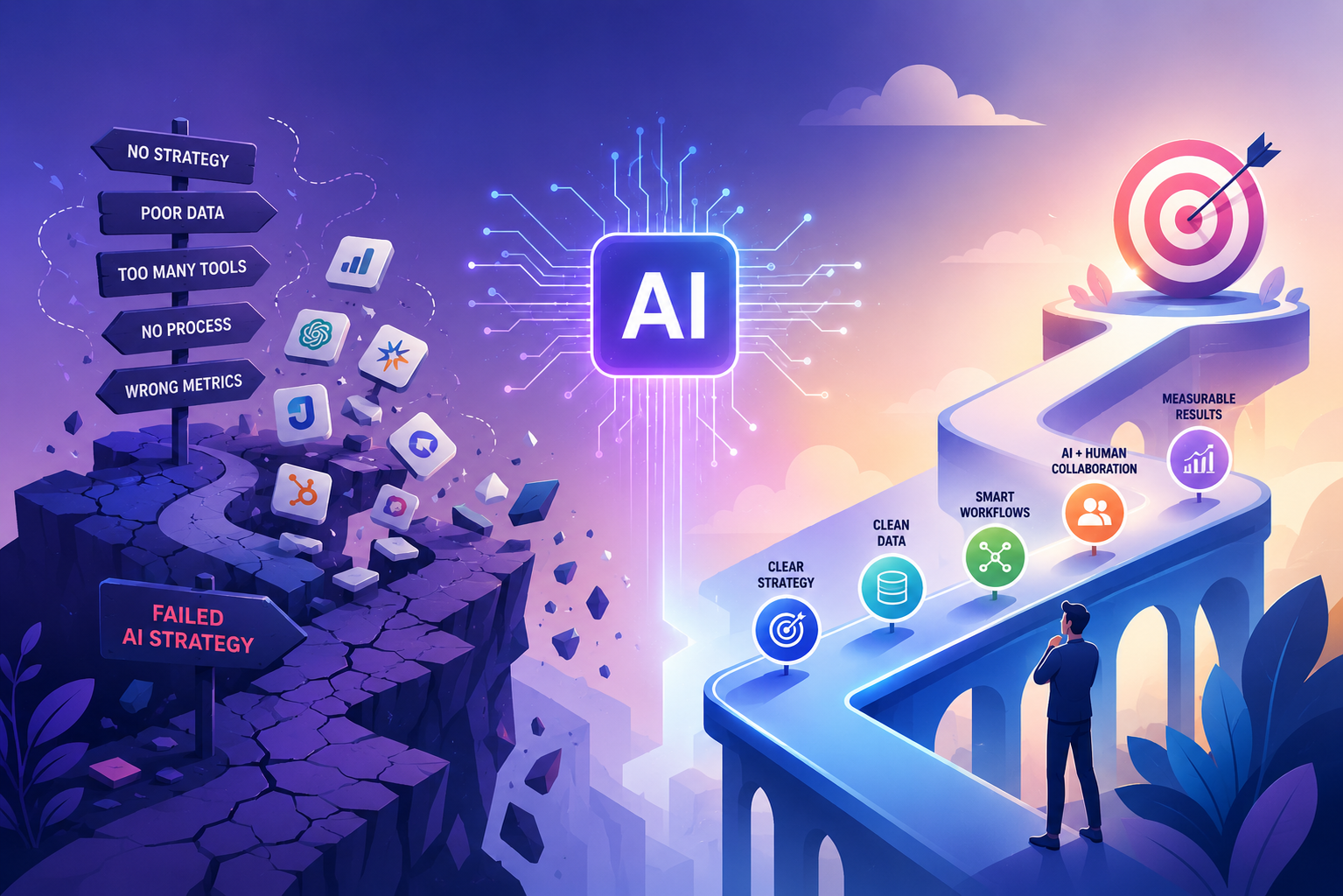
If your system is broken, AI helps you fail at scale.
This article explores why most AI marketing strategies fail, what separates successful organizations from unsuccessful ones, and the practical framework marketing leaders should follow over the next five years.
AI Isn’t the Strategy
One of the biggest misconceptions in marketing today is treating AI as a strategy.
It isn’t.
AI is infrastructure.
Think about electricity.
No company claims its competitive advantage comes from electricity.
Electricity powers the business.
Strategy determines how the business competes.
AI works the same way.
Yet countless boardroom conversations begin like this:
“We need an AI strategy.”
The better question is:
“How can AI strengthen our existing business strategy?”
That subtle shift changes everything.
Successful marketing organizations don’t ask:
- Which AI tools should we buy?
Instead, they ask:
- Which customer problems can we solve better?
- Which marketing processes create unnecessary friction?
- Which decisions could become faster?
- Which repetitive tasks should disappear completely?
Those questions lead to measurable business outcomes.
The first question leads to software subscriptions.
The AI Adoption Trap
I’ve observed five common stages whenever companies begin adopting AI.
Unfortunately, many never progress beyond the first stage.
Stage 1: Tool Excitement
The team discovers ChatGPT.
Someone experiments with image generation.
Another employee purchases an AI copywriting tool.
A designer starts using AI-assisted creative generation.
Everyone feels incredibly productive.
For about two weeks.
Nothing is documented.
No standards exist.
Every employee develops their own prompting style.
Outputs vary wildly.
The excitement gradually fades.
Stage 2: Tool Proliferation
Soon, every department purchases different AI products.
Marketing uses one platform.
Sales adopts another.
Customer success experiments elsewhere.
Operations buys something completely different.
Now the organization owns:
- six AI writing tools
- three meeting assistants
- four automation platforms
- multiple analytics copilots
Ironically, productivity often decreases.
Why?
Because complexity grows faster than capability.
Instead of one disconnected software stack, companies now manage an even larger disconnected AI stack.
This is also where many organizations would benefit from evaluating specialized solutions rather than defaulting to a single model. If you’re comparing options, my guide to the Best ChatGPT Alternatives for Productivity explains when purpose-built AI tools outperform general-purpose assistants.
Stage 3: Executive Pressure
Leadership begins asking uncomfortable questions.
“We invested significantly in AI.”
“So where’s the ROI?”
The marketing team responds with metrics like:
- 400 blog posts generated
- 12,000 prompts executed
- 30% faster copy creation
- Hundreds of AI-generated creatives
These metrics sound impressive.
But they rarely answer the questions CEOs and CFOs actually care about:
- Did revenue increase?
- Did customer acquisition costs decrease?
- Did campaign conversion rates improve?
- Did customer lifetime value grow?
- Did operational costs fall?
- Did the marketing team ship more high-impact work with the same headcount?
This is where many AI initiatives lose executive sponsorship.
Not because AI failed.
Because success was measured incorrectly.
The Biggest Mistake: Buying Tools Before Solving Problems
If I could eliminate one mistake from the AI marketing industry, it would be this:
Stop shopping for AI tools before identifying your biggest operational bottleneck.
Too many organizations begin with procurement.
They compare features.
They negotiate licenses.
They evaluate pricing.
Only afterwards do they ask:
“What problem are we actually trying to solve?”
That order should be reversed.
Instead, start with the bottleneck.
For example:
Problem: Campaign launch cycles take three weeks.
Now ask:
Can AI reduce briefing time?
Can AI automate creative variations?
Can AI generate audience insights?
Can AI summarize campaign performance?
Can AI speed up approvals?
Now AI has a measurable purpose.
Notice that the strategy begins with a business constraint—not a piece of software.
AI Is a Multiplier, Not a Miracle
One lesson has consistently proven true across industries:
AI magnifies the quality of your existing marketing system.
Imagine two organizations.
Company A
- Poor CRM hygiene
- No documentation
- Weak campaign planning
- Disconnected analytics
- Inconsistent messaging
- Manual reporting
- Undefined KPIs
Now introduce AI.
What happens?
The company creates more content.
More reports.
More dashboards.
More emails.
More noise.
Nothing fundamentally improves because the underlying system remains broken.
Company B
- Clean first-party data
- Well-defined customer journeys
- Standardized campaign workflows
- Clear ownership
- Reliable attribution
- Experimentation culture
- Shared documentation
The same AI tools now produce very different outcomes.
Campaigns launch faster.
Insights become more actionable.
Personalization scales without sacrificing quality.
Teams spend less time on repetitive execution and more time on strategic thinking.
The technology is identical.
The operating system isn’t.
This distinction explains why one organization sees AI as a cost center while another turns it into a durable competitive advantage.
The 7 Reasons Most AI Marketing Strategies Fail
After watching dozens of organizations experiment with AI over the past few years, I’ve noticed a pattern.
The failures aren’t random.
They’re surprisingly predictable.
Here are the seven biggest reasons AI marketing initiatives fail—and what high-performing teams do differently.
1. They Confuse Content Velocity with Business Growth
One of AI’s greatest strengths is speed.
In minutes, it can generate:
- Blog posts
- Ad copy
- Email campaigns
- Product descriptions
- Social media captions
- Landing page variations
That speed is impressive—but it’s also deceptive.
Many teams mistake increased output for increased impact.
Publishing five times more content doesn’t automatically generate five times more traffic. In fact, it often creates the opposite problem: more mediocre content competing for the same audience’s attention.
Google’s Helpful Content System has made one thing clear: originality, expertise, and usefulness matter more than volume.
AI can accelerate content production, but it cannot manufacture first-hand experience, industry judgment, or unique perspectives.
That’s where marketers create value.
A better question than “How much content can AI produce?” is:
“What valuable insight can only our company provide?”
When AI amplifies proprietary knowledge instead of generic information, it becomes a competitive advantage.
This philosophy also complements my article on Performance Marketing Trends in 2026, where I discuss why quality signals increasingly outweigh sheer publishing frequency.
2. They Skip Process Design
Most organizations introduce AI into chaotic environments.
Imagine asking AI to automate a campaign launch process that already involves:
- Six approvers
- Multiple spreadsheets
- Three communication tools
- Manual reporting
- Last-minute creative changes
Automation doesn’t simplify chaos.
It accelerates it.
Before introducing AI into any workflow, ask:
- Can this process be simplified?
- Are responsibilities clearly defined?
- Are approval layers necessary?
- Can repetitive decisions be standardized?
Only then should AI enter the picture.
The best AI implementation projects begin with process mapping—not prompt engineering.
3. They Ignore Data Quality
Every marketer wants better AI outputs.
Few invest in better AI inputs.
Data quality is the hidden variable that determines AI success.
If your CRM contains:
- duplicate contacts
- outdated customer information
- incomplete lifecycle stages
- inconsistent naming conventions
- inaccurate attribution
then every AI system built on top of it inherits those weaknesses.
Garbage in.
Garbage out.
This becomes especially dangerous in enterprise environments, where AI begins making recommendations around audience segmentation, budget allocation, or personalization.
The model isn’t “wrong.”
It’s responding accurately to inaccurate data.
Before investing in sophisticated AI tools, invest in:
- CRM hygiene
- first-party data collection
- standardized taxonomy
- attribution accuracy
- analytics governance
These aren’t glamorous investments.
They’re foundational ones.
4. They Treat AI Like an Employee Instead of Infrastructure
One of the biggest misconceptions surrounding AI is anthropomorphism.
Organizations often ask:
“Can AI replace our copywriter?”
or
“Can AI become our marketing manager?”
These questions frame AI as a person.
That’s the wrong mental model.
Think of AI as infrastructure.
Much like cloud computing or APIs, AI provides capabilities—not accountability.
It doesn’t own outcomes.
People do.
The strongest marketing teams use AI to extend human capability rather than eliminate it.
For example:
AI researches.
Humans prioritize.
AI drafts.
Humans refine.
AI summarizes.
Humans decide.
AI predicts.
Humans exercise judgment.
That balance is where sustainable performance emerges.
5. They Chase Every New Tool
The AI ecosystem evolves at extraordinary speed.
Every week brings another:
- AI video generator
- AI research assistant
- AI analytics platform
- AI design tool
- AI sales copilot
- AI coding assistant
It’s tempting to believe the next tool will solve existing problems.
Usually, it doesn’t.
Instead, organizations accumulate:
- overlapping subscriptions
- disconnected workflows
- inconsistent outputs
- duplicated functionality
- increased training requirements
Tool accumulation rarely creates operational excellence.
Integration does.
Instead of asking:
“What new AI software should we buy?”
Ask:
“Can our existing systems communicate more effectively?”
That’s why I generally recommend building a focused AI stack rather than assembling dozens of disconnected tools. If you’re evaluating options, my guide to Best AI Tools for Small Businesses in 2026 provides a practical framework for choosing solutions based on business needs rather than hype.
6. They Remove Humans from Critical Decisions
Automation is valuable.
Autonomy is risky.
There’s a meaningful difference.
The best marketing organizations maintain a human-in-the-loop approach for decisions involving:
- brand voice
- pricing
- compliance
- customer trust
- crisis communications
- strategic positioning
- budget allocation
These decisions require context, ethics, and business judgment.
AI can surface options.
Humans determine which option aligns with the organization’s goals.
Companies that forget this often experience subtle brand erosion.
Not because AI generated poor content.
Because nobody applied editorial judgment before publishing it.
7. They Expect Immediate ROI
Perhaps the biggest misconception surrounding AI is the belief that implementation produces instant transformation.
It doesn’t.
AI maturity resembles digital transformation.
The benefits compound over time.
Organizations typically progress through several stages before AI meaningfully impacts revenue.
Understanding those stages helps set realistic expectations.
The AI Marketing Maturity Model
I’ve found it useful to think about AI adoption as a progression rather than a binary state.
Organizations don’t become “AI-powered” overnight.
They mature through increasingly sophisticated capabilities.
Level 1 — AI Assistant
At this stage, AI improves individual productivity.
Typical use cases include:
- writing first drafts
- brainstorming campaigns
- summarizing meetings
- generating ideas
- translating content
The impact is real but limited.
Most companies currently operate here.
Level 2 — AI Workflow
AI becomes embedded into repeatable marketing processes.
Examples include:
- email creation
- campaign reporting
- SEO optimization
- landing page generation
- creative testing
- customer support
Instead of helping one employee, AI begins helping entire teams.
This is also where automation platforms become increasingly important. Teams looking to streamline repetitive work can benefit from approaches similar to those covered in my guide on Best Automation Tools for Solo Workers in 2026, even at enterprise scale.
Level 3 — AI Decision Support
Here, AI starts influencing business decisions.
Examples include:
- predictive forecasting
- campaign optimization
- churn prediction
- budget allocation
- audience segmentation
- media mix modeling
Notice the shift.
AI isn’t simply creating content anymore.
It’s informing strategy.
Level 4 — AI Operating System
This is where organizations begin separating themselves from competitors.
AI now connects:
- CRM
- CDP
- analytics
- advertising platforms
- customer service
- marketing automation
- reporting systems
Instead of isolated AI experiments, the business operates through an interconnected intelligence layer.
Reporting becomes significantly faster, and insights move from retrospective to proactive. That’s the evolution I explored in The Ultimate Guide to AI-Powered Client Reporting, where AI transforms reporting from a manual task into a decision-support system.
Level 5 — AI Competitive Advantage
Very few organizations currently operate here.
AI isn’t a feature.
It isn’t even a department.
It’s infrastructure.
The organization:
- learns faster
- experiments faster
- personalizes faster
- launches faster
- optimizes faster
Competitors can copy individual campaigns.
They cannot easily copy the operating model.
That becomes the moat.
The Framework I Recommend to Marketing Leaders
When executives ask me where to begin with AI, I avoid recommending specific software.
Tools change every few months.
Principles endure.
Instead, I recommend thinking in terms of five interconnected pillars.
1. People
Train marketers to think critically with AI, not simply prompt it.
Build AI literacy across the organization so every team understands both the strengths and limitations of the technology.
2. Process
Document, simplify, and standardize workflows before introducing automation.
A clear process is easier to optimize than a chaotic one.
3. Platform
Choose tools that integrate well with your existing martech stack.
Avoid creating another layer of disconnected technology.
4. Performance
Measure outcomes that matter:
- Revenue
- CAC
- ROAS
- CLV
- Pipeline contribution
- Campaign velocity
- Operational efficiency
Vanity metrics rarely survive executive scrutiny.
5. Progress
Treat AI adoption as a continuous capability-building exercise rather than a one-time implementation project.
Small, measurable improvements compounded over months consistently outperform ambitious but poorly executed transformations.
The AI Marketing Operating System
One pattern has become increasingly clear as I observe organizations adopting AI:
The winners don’t simply use AI.
They redesign how marketing operates.
I call this the AI Marketing Operating System (AI-MOS).
It’s not a software platform.
It’s a way of organizing people, processes, data, and technology so AI consistently delivers business value.
Imagine five interconnected layers.
Layer 1: Strategy
Everything begins with business objectives.
Ask questions like:
- Are we trying to reduce CAC?
- Improve ROAS?
- Increase customer retention?
- Shorten campaign launch cycles?
- Improve marketing productivity?
AI should never exist as an isolated initiative. It should always support a clearly defined business objective.
Layer 2: Data
AI cannot outperform poor data.
Successful organizations prioritize:
- Clean CRM records
- Unified customer profiles
- First-party data
- Reliable attribution
- Consistent naming conventions
- Governance policies
Think of data as the fuel that powers every AI workflow.
Layer 3: Workflows
This is where AI creates operational leverage.
Examples include:
- Campaign planning
- Keyword research
- Content briefs
- Landing page optimization
- Email personalization
- Reporting
- Creative testing
- Audience segmentation
- Customer support
- Competitive intelligence
Every repeatable workflow is an opportunity to save time without sacrificing quality.
Layer 4: Decision Intelligence
This is where AI moves beyond execution.
Instead of asking AI to create more assets, leading teams ask it to answer better questions.
Examples include:
- Which campaigns deserve additional budget?
- Which audience segments are underperforming?
- Which customers are likely to churn?
- Which landing pages need optimization?
- Which keywords represent the next growth opportunity?
This is the point where AI becomes a strategic advisor—not just a production assistant.
Layer 5: Continuous Learning
High-performing organizations don’t treat AI as a project with an end date.
They build systems that learn.
Every campaign becomes new training data.
Every experiment informs the next.
Every insight improves future decisions.
That creates compounding advantages that are difficult for competitors to replicate.
A 90-Day AI Roadmap for Marketing Leaders
One of the biggest mistakes organizations make is trying to transform everything at once.
A phased rollout is faster, safer, and easier to measure.
Days 1–30: Audit
Inventory your existing martech stack and identify repetitive tasks.
Interview stakeholders to understand where teams lose the most time.
Measure baseline metrics such as campaign cycle time, content production speed, reporting effort, CAC, and ROAS.
Days 31–60: Standardize
Document your highest-impact workflows.
Remove unnecessary approvals.
Define success metrics.
Assign clear ownership for AI-enabled processes.
Train teams on prompting, verification, and governance.
Days 61–90: Automate
Select one or two workflows with the highest business impact.
Examples:
- Weekly reporting
- SEO content briefs
- Paid search analysis
- Email segmentation
- Creative variation generation
Measure results.
Gather feedback.
Iterate.
Expand only after proving value.
AI Governance: The Missing Conversation
Most discussions around AI focus on capabilities.
Far fewer focus on responsibility.
As AI becomes deeply embedded in marketing operations, governance becomes essential.
Marketing leaders should establish clear policies around:
- Human review before publication
- Customer data privacy
- Copyright and intellectual property
- Prompt documentation
- Model selection
- Brand voice consistency
- Compliance requirements
- AI disclosure where appropriate
Governance isn’t about slowing innovation.
It’s about enabling innovation safely and sustainably.
The Future of AI Marketing
Over the next five years, AI will become less visible—but more influential.
Marketers won’t spend their days opening separate AI tools.
AI will be embedded into every platform they already use:
- CRM systems
- Advertising platforms
- Analytics dashboards
- Customer support software
- CMS platforms
- Marketing automation tools
The conversation will shift from:
“Which AI tool do we use?”
to:
“How intelligently does our business operate?”
The organizations that thrive won’t necessarily have the biggest AI budgets.
They’ll have the clearest systems, the cleanest data, and the strongest culture of experimentation.
Final Thoughts
AI is changing marketing—but not in the way many people expected.
The biggest advantage won’t belong to companies that publish the most AI-generated content.
It won’t belong to those with the largest AI software budgets.
And it certainly won’t belong to teams chasing every new product launch.
Instead, the winners will be organizations that combine human judgment, high-quality data, disciplined processes, and AI into a single operating model.
Technology is becoming increasingly accessible.
Execution remains scarce.
That is where competitive advantage will continue to exist.
If there’s one takeaway I’d like you to remember, it’s this:
Don’t build an AI strategy. Build a better marketing system—and let AI amplify it.

Leave a Reply