
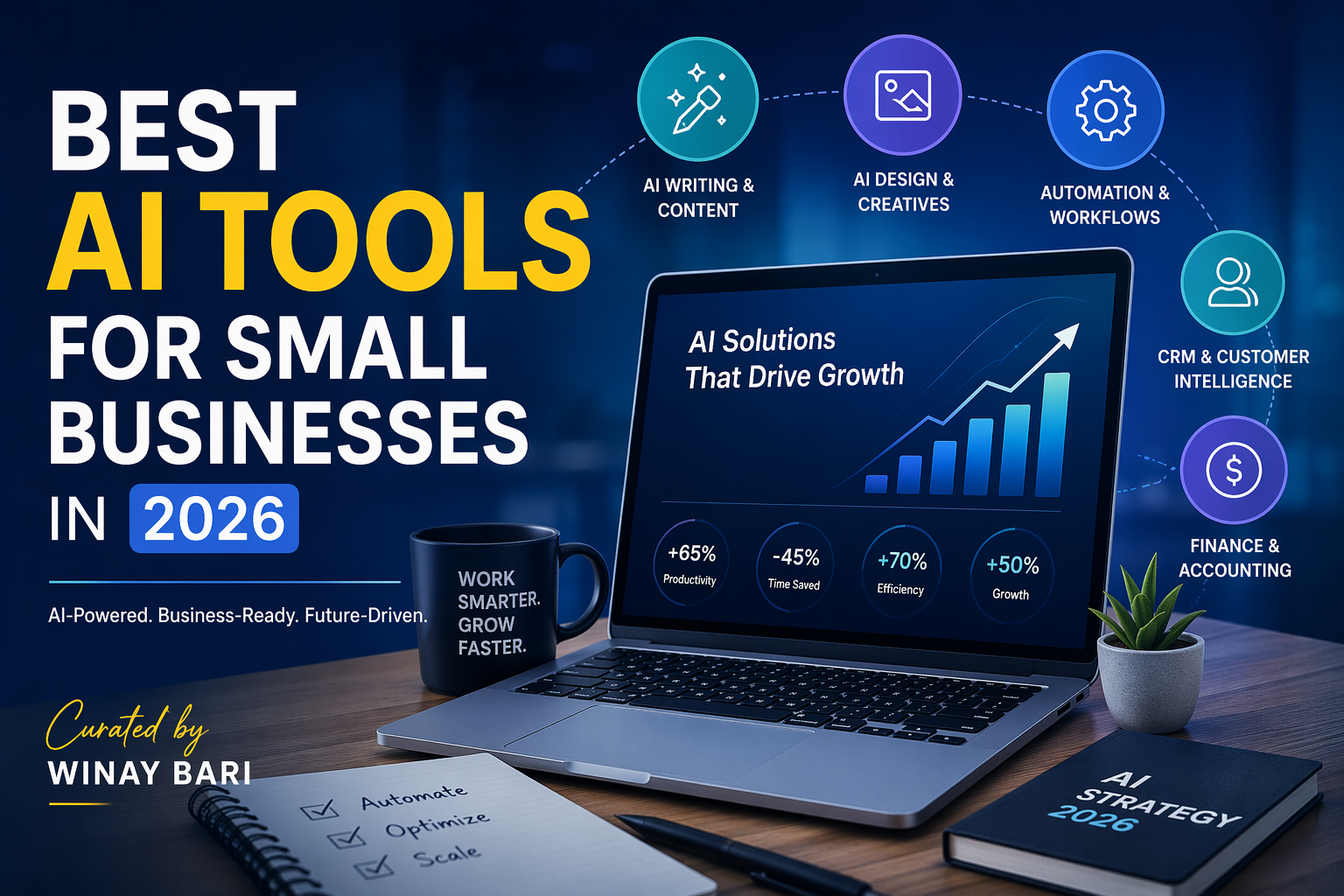
Artificial intelligence has officially crossed the threshold from “nice-to-have” to mission-critical. In 2026, small businesses that leverage AI effectively are outperforming competitors not through scale, but through smarter systems.
After analysing top-performing content, real-world case studies, and emerging SaaS trends, one thing is clear: the best AI tools are not the most complex—they’re the ones that eliminate friction, reduce costs, and amplify output.
This guide breaks down exactly what works.
Why AI Is Now Essential for Small Businesses
The Shift from Optional to Operational
AI is no longer a competitive edge—it’s baseline infrastructure. From marketing to finance, AI tools are now embedded into everyday workflows.
ROI-Driven Adoption Trends
Small businesses are prioritising:
- Time savings over features
- Automation over manual effort
- Scalability without hiring
The result: lean teams achieving enterprise-level output.
The Core AI Stack Every Small Business Needs
AI for Writing, Strategy & Operations
The foundation of any AI-driven business is a strong thinking and execution engine.
👉 Best Tool: ChatGPT
ChatGPT remains the most versatile AI tool for small businesses in 2026. It functions as a multi-purpose business co-pilot, capable of handling:
- Email communication
- Proposal generation
- Market research
- SOP creation
- Customer support scripting
Its strength lies in adaptability—whether you’re a freelancer, agency, or startup founder.
Key takeaway: Master prompting here before adding more tools. This is your highest ROI starting point.
AI for Design & Content Creation
Visual content is no longer a bottleneck for small teams.
👉 Best Tool: Canva AI
Canva AI has evolved into a prompt-first creative engine, allowing businesses to:
- Generate social media creatives instantly
- Build presentations with AI
- Create ad campaigns without designers
- Maintain brand consistency automatically
This eliminates the need for expensive creative resources for everyday marketing
Key takeaway: Canva AI has faster execution, lower costs, and consistent branding.
AI for Automation & Workflows
Automation is where AI shifts from assistance to leverage.
👉 Best Tool: Zapier
Zapier enables seamless integration between apps, allowing you to automate:
- Lead capture → CRM entry → follow-up emails
- Marketing workflows
- Internal task management
- Cross-platform data syncing
Businesses implementing automation correctly report saving 15–25 hours per week
Insight: AI generates output. Automation multiplies it. Without automation, AI remains underutilised.
AI for CRM, Finance & Knowledge Management
Operational intelligence is now AI-driven.
👉 Best Tool: HubSpot CRM
This is something I have worked on and utilised its capability to the core, and found it better than any other tool available. HubSpot CRM stands out as the most comprehensive solution for small businesses, offering:
- AI-powered lead scoring
- Customer behaviour insights
- Automated follow-ups
- Sales pipeline tracking
For finance and knowledge management, AI integrations across platforms now enable:
- Automated bookkeeping
- Smart forecasting
- Centralised business knowledge systems
Outcome: Better decisions, less manual work, improved customer retention..
The Rise of All-in-One AI Platforms
A major trend in 2026 is consolidation.
Instead of juggling multiple tools, businesses are adopting platforms that combine:
- Content generation
- Design
- Automation
- Analytics
This reduces costs, simplifies onboarding, and improves workflow efficiency.
Common Mistakes to Avoid
Most businesses don’t fail at AI because of poor tools—they fail due to poor implementation.
Avoid these pitfalls:
- Using too many tools without a system
- Chasing features instead of outcomes
- Not training teams on effective usage
Rule: One use case → one tool → master it → scale.
Final Thoughts: Building an AI-First Business
AI adoption is nearly universal—but effective usage is not.
The businesses winning in 2026 follow a different approach:
- They build systems, not stacks
- They optimise for time saved
- They automate repetitive workflows first
My Perspective:
Precision beats volume. The goal isn’t more AI tools—it’s smarter execution.
FAQs
1. What is the best AI tool for small businesses in 2026?
Tools like ChatGPT, Canva AI, Zapier, and HubSpot CRM form a powerful core stack depending on your needs.
2. Are AI tools affordable for small businesses?
Yes. Most tools offer scalable pricing, including free and low-cost plans.
3. How should I start using AI?
Begin with one area—content, automation, or CRM—then expand based on measurable ROI.

Leave a Reply